A slow drain is easy to ignore at first. The kitchen sink takes an extra few seconds to empty. The shower leaves a little puddle around your feet. Then one Saturday morning the sink starts gurgling, the toilet bubbles, and suddenly half the house seems to have an opinion about your plumbing.
This is where hydro jetting often enters the conversation.
Hydro jetting is a professional drain and sewer cleaning method that sends highly pressurized water through a pipe. Unlike a basic drain snake, which may break through a blockage and create a path for water, hydro jetting can clean material from the inner walls of the pipe as it moves through the line.
Grease, sludge, soap residue, mineral buildup, sediment and some root intrusion can all be targets, depending on the condition of the pipe and the equipment being operated.
Sounds simple enough: water goes in, grime comes out.
But there is a little more to it.
Hydro jetting is powerful equipment. It is not automatically the right answer for every clogged drain, and it should not be performed blindly on an old or damaged sewer line. A good plumber normally wants to understand why the line is blocked before blasting water through it.
For U.S. homeowners comparing drain cleaning options, the real question is rarely “Does hydro jetting work?”
It does.
The better question is whether it makes sense for your particular pipe.
What is hydro jetting?
Hydro jetting, sometimes called water jetting or sewer jetting, cleans drain and sewer pipes with a controlled stream of high-pressure water.
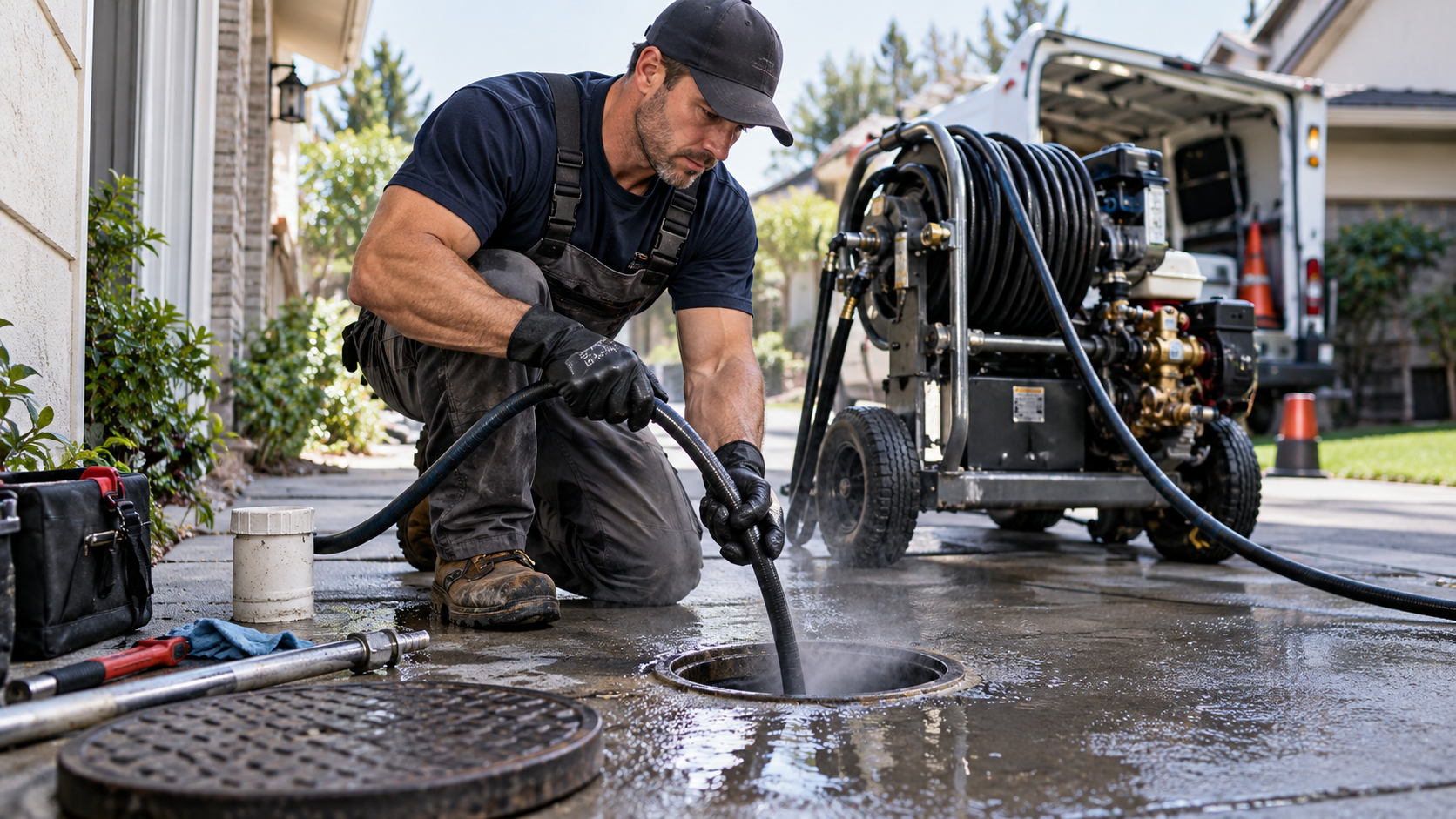
A professional machine supplies water to a specialized hose. At the end of that hose sits a jetting nozzle with openings positioned in different directions.
Some jets point backward. They help propel the hose deeper into the line while washing loosened material toward the access point or sewer flow path.
Other nozzle designs concentrate more water forward to attack stubborn obstructions.
The technician selects the nozzle, flow and pressure according to the pipe size, blockage and condition.
That last part matters. Hydro jetting is not simply “maximum pressure everywhere.”
Think of it more like pressure washing inside a pipe, except the operator cannot see most of the surface directly. That is one reason camera inspection can be so important.
How hydro jetting works step by step
The exact process varies between plumbing companies, but a professional job usually follows the same general logic.
- The plumber identifies the symptoms and determines which section of the drain or sewer system is likely involved.
- A sewer camera may be inserted to check for grease, roots, heavy buildup, broken sections, offsets, corrosion or other structural problems.
- The technician selects an appropriate jetting nozzle and operating settings.
- The hose enters through a cleanout or another suitable access point.
- High-pressure water loosens deposits and pushes debris through the drainage system.
- The plumber may make several passes when the line has years of buildup.
- A follow-up camera inspection may be performed to confirm that the pipe is clear and to reveal damage that was previously hidden by debris.
The most useful part is not simply removing the center of a clog.
The goal is often to clean much more of the pipe’s internal surface.
That difference explains why hydro jetting can make sense when a line keeps clogging again after ordinary snaking.
Hydro jetting vs. snaking: what’s actually different?
Drain snakes and hydro jets solve related problems, but they do not work the same way.
A drain snake – also called a plumbing auger – sends a cable into the pipe. The cable may break through a clog, retrieve material or cut through certain obstructions with an attached head.
It can be exactly what is needed for a simple blockage.
Hydro jetting attacks buildup with water across a broader section of the pipe wall.
| Feature | Drain Snaking | Hydro Jetting |
|---|---|---|
| Main action | Breaks through, hooks or cuts blockage | Washes and scours buildup from the pipe |
| Best for | Simple clogs and specific obstructions | Heavy grease, sludge and recurring buildup |
| Pipe-wall cleaning | Limited | Much more thorough when appropriate |
| Water required | Minimal | Significant water flow |
| Equipment | Mechanical cable or auger | High-pressure pump, hose and nozzle |
| Old damaged pipes | Still requires care | Inspection is especially important |
| Recurring grease problems | May open the line temporarily | Often better at removing wall buildup |
Neither method wins every time.
A plumber who recommends hydro jetting for every slow bathroom sink is probably oversimplifying the job.
Sometimes a small mechanical cleaning is enough.
On the other hand, repeatedly snaking a sewer line coated with thick grease may only create a temporary tunnel through the mess.
That is when more thorough cleaning starts to make sense.
What can hydro jetting remove?
Hydro jetting is especially good at removing material that sticks to the inside of a pipe.
Kitchen grease is a classic example.
Hot grease may enter a drain as liquid, but it does not necessarily stay that way. As it cools, it can coat the pipe. Food particles and other debris then cling to that layer.
Over time, the opening becomes smaller.
The drain may still work, just more slowly. Then one more load from the dishwasher or sink pushes the line over the edge.
Jetting can strip away much of that buildup rather than merely punching through its center.
Other common targets include:
- grease and cooking residue;
- soap and organic sludge;
- sediment and loose mineral deposits;
- mud or debris inside some exterior drain lines;
- food residue in commercial kitchen lines;
- certain types of scale buildup;
- small or moderate root intrusion when the pipe itself remains structurally sound.
But hydro jetting cannot repair a broken sewer pipe.
It cannot reconnect a separated joint.
It cannot correct a pipe that has collapsed.
And it cannot fix a belly – a low section where wastewater repeatedly collects because the pipe has lost proper slope.
Cleaning and repair are different jobs.
Can hydro jetting remove tree roots?
Sometimes, yes.
This is one of the questions homeowners ask most often.
Tree and shrub roots naturally seek moisture. If an underground sewer pipe has a crack, loose joint or another opening, small roots can enter. Once inside, they may continue growing and trap toilet paper and waste.
Specialized cutting nozzles and sewer jetting equipment can remove some root intrusion.
But removing roots does not repair the opening that allowed them inside.
That distinction is crucial.
If roots entered through a damaged joint, clearing them may restore flow today while leaving the structural problem untouched.
They can return.
A camera inspection after cleaning can help determine whether the line needs repair, lining, replacement or monitoring.
If someone tells you that hydro jetting permanently solves every root problem, be skeptical.
Can hydro jetting damage pipes?
Properly performed hydro jetting is commonly carried out on sound drainage systems.
But high-pressure water is powerful, and not every pipe is in good condition.
An older sewer line may already have cracks, severe corrosion, weakened joints or partial collapse.
Clay sewer pipes can have displaced joints.
Cast-iron piping can deteriorate internally over decades.
Orangeburg pipe, found in some older American homes, presents its own structural concerns because it is made from bituminous fiber material rather than modern plastic or metal.
That is why an inspection matters.
If the pipe is already failing, aggressive cleaning may expose or worsen a problem that was hidden by debris.
The key point is not that hydro jetting is inherently dangerous.
The key point is that pipe condition comes first.
When a sewer camera should come before hydro jetting
A camera is especially valuable when there is any reason to suspect structural trouble.
This may include an older home, a history of sewer backups, large trees near the sewer path, repeated root problems, previous repairs or unexplained recurring blockages.
The camera can show the plumber what ordinary guesswork cannot.
Is the pipe simply dirty?
Is there a mass of roots?
Has one section shifted?
Is there standing water where the pipe should be draining?
Is a foreign object stuck in the line?
That information changes the cleaning plan.
It can also prevent a homeowner from paying for repeated drain cleaning when the real problem is structural.
Signs hydro jetting may make sense
A single clogged bathroom sink usually does not scream “hydro jet the sewer.”
Recurring problems are more interesting.
If multiple fixtures drain slowly at once, especially on the lowest level of the home, the issue may be farther downstream.
Other clues can include bubbling toilets, sewer odors, backups that return shortly after mechanical cleaning or a kitchen line that repeatedly clogs with greasy residue.
Hydro jetting may be worth discussing when:
- the same drain or sewer line clogs repeatedly;
- grease buildup is known or strongly suspected;
- a previous snake opened the line but the problem returned quickly;
- several fixtures show symptoms at the same time;
- a camera reveals heavy buildup along the pipe walls;
- a commercial kitchen needs thorough drain-line cleaning;
- root intrusion has been identified and the pipe remains suitable for jetting.
Notice the phrase “may be worth discussing.”
Symptoms alone do not prove that hydro jetting is the answer.
When hydro jetting may not be the right choice
Sometimes people hear “powerful drain cleaning” and assume more power must be better.
Not really.
If a pipe has collapsed, it needs repair.
If a sewer line is severely broken, blasting water through it is not a substitute for fixing it.
If a child dropped a solid toy into a toilet and it is lodged close to the fixture, another removal method may make far more sense.
If one sink trap contains a simple hair clog, bringing in sewer jetting equipment would be excessive.
Plumbing is full of situations where the least dramatic method is the right one.
What happens during a hydro jetting appointment?
For the homeowner, the process is usually less dramatic than the equipment sounds.
The plumber first locates an appropriate access point, often a sewer cleanout.
If the cleanout sits outdoors, much of the work may happen outside the house.
The technician then feeds the jetting hose into the line and runs the machine in controlled passes.
The rear-facing water jets help drive the hose through the pipe while sending loosened debris in the intended direction.
Depending on the line, the technician may change nozzles or make additional passes.
Heavy grease can take time.
Roots may need a specialized cutting head.
A line that simply contains accumulated sludge may clean more quickly.
Afterward, the plumber may run a camera through the pipe again.
That second look can be extremely informative because buildup that previously covered the pipe walls is now gone.
Cracks, corrosion or rough sections may suddenly become visible.
How much pressure does hydro jetting use?
Professional hydro jetting machines can operate at very high pressures, but there is no single pressure setting that should be applied to every pipe.
The operating setup depends on several factors, including pipe material, diameter, length, blockage type and structural condition.
Flow rate matters too.
People often focus only on PSI because it sounds impressive.
But effective sewer cleaning depends on the entire equipment setup, including water volume, nozzle pattern and operator technique.
A higher number does not automatically mean a better cleaning job.
In fact, an experienced plumber should be thinking about control, not bragging rights.
How long does hydro jetting take?
There is no reliable one-size-fits-all answer.
A relatively straightforward residential line may be cleaned in one visit without much drama.
A heavily coated commercial line may require more work.
Roots, difficult access, long runs and repeated passes can add time.
Camera inspection also extends the appointment, although it can save a lot of guessing later.
If you are requesting a quote, ask whether the estimated service time includes camera work, setup and final inspection.
That makes comparisons between companies more meaningful.
What does hydro jetting cost in the USA?
Prices vary too much across the United States to treat one internet number as a national standard.
Labor rates in New York City, rural Ohio, Southern California and suburban Texas can be very different.
The job itself also changes the price.
A short residential line with a clean exterior access point is not the same job as a long sewer line with difficult access and root intrusion.
Commercial drain work is another category again.
| Factor | Why it can affect the bill |
|---|---|
| Length of the pipe | Longer runs may require more cleaning time |
| Type of blockage | Heavy grease or roots can require extra passes or specialized nozzles |
| Access | An accessible cleanout generally simplifies the job |
| Pipe diameter | Equipment requirements can change with line size |
| Camera inspection | Some companies include it; others charge separately |
| Emergency service | Night, weekend or urgent appointments may cost more |
| Local labor rates | Plumbing prices differ substantially between U.S. markets |
| Commercial vs. residential | Commercial systems may involve larger equipment and more extensive cleaning |
Instead of asking only “How much is hydro jetting?” ask what the quote includes.
Does it include a camera inspection?
Is there a separate service-call charge?
Does the company perform a post-cleaning inspection?
What happens if the technician discovers a broken pipe instead of ordinary buildup?
Those answers tell you more than a low headline price.
Hydro jetting for kitchen drain grease
Kitchen drains are one of the areas where hydro jetting can really show its strength.
Grease does not always form one neat plug.
It may coat a long section of pipe.
A mechanical cable can create an opening through that material while leaving much of the greasy layer behind.
Water jetting can clean a larger portion of the pipe wall.
Restaurants and food-service businesses deal with this issue on a much bigger scale, which is why jetting is common in commercial drain maintenance.
Residential kitchens can develop similar buildup over the years, just more slowly.
And no, pouring boiling water down a greasy drain is not a reliable substitute for professional cleaning.
The grease may simply move farther into the system and cool there.
Can hydro jetting help with recurring clogs?
Yes, when the recurrence is caused by material stuck along the pipe wall.
Imagine a sewer line whose opening has narrowed because of years of buildup.
A snake creates a channel.
The drain works again.
Then paper and waste begin catching on the remaining material.
The clog returns.
Hydro jetting may remove far more of the underlying buildup, giving the pipe a cleaner internal surface.
But recurring clogs can also signal structural trouble.
If the pipe is cracked, offset or sagging, cleaning alone will not stop the cycle.
This is why camera inspection keeps coming up.
It separates “dirty pipe” problems from “damaged pipe” problems.
What about chemical drain cleaners?
Homeowners often reach for a bottle before calling a plumber.
For a minor clog, people sometimes get temporary relief.
But chemical drain cleaners are not the same thing as physically cleaning a sewer line.
They can also complicate professional work if harsh chemicals remain trapped in standing water.
If you have already poured a chemical drain product into the line, tell the plumber before anyone opens or works on the system.
That is basic safety information.
For persistent backups, identifying the actual obstruction is far more useful than repeatedly adding chemicals.
Is hydro jetting environmentally friendly?
Hydro jetting primarily relies on water rather than chemical drain-clearing products.
That can be an advantage in situations where mechanical cleaning with water is appropriate.
Still, calling any plumbing procedure automatically “eco-friendly” oversimplifies things.
The process consumes water and energy, and wastewater still carries whatever material has been removed from the pipe into the sewer system.
A better way to describe hydro jetting is that it can clean drains without depending on caustic chemical cleaners.
That is a specific benefit without turning the service into a green marketing slogan.
Can you hydro jet a sewer line yourself?
Professional sewer jetting equipment is not the same as attaching a little drain hose to a consumer pressure washer.
High-pressure water can injure people, damage property and create serious problems when equipment is handled incorrectly.
The operator also needs to understand pipe condition, nozzle selection, hose behavior and access-point safety.
There is another issue people overlook: diagnosis.
Even if someone can get water through a line, that does not mean they know whether the pipe is cracked, collapsed or full of roots.
For a main sewer line, professional evaluation is generally the sensible route.
How often should a sewer line be hydro jetted?
Most single-family homes do not need hydro jetting on a fixed calendar simply because a year has passed.
A healthy sewer line that flows well does not need aggressive cleaning for the sake of it.
Maintenance schedules make more sense in settings where recurring buildup is predictable.
Restaurants are the obvious example because grease loads can be substantial.
Certain multifamily or commercial buildings may also develop repeat problems in known sections of the drainage system.
For a typical homeowner, symptoms and inspection findings matter more than an arbitrary annual schedule.
Hydro jetting before buying a house
Here is a situation that catches buyers off guard.
A sewer camera may show heavy buildup, roots or standing water during a home inspection.
Hydro jetting can sometimes be recommended so the line can be properly cleaned and inspected.
But do not treat cleaning as proof that the sewer is structurally fine.
A dirty pipe can hide defects.
After cleaning, the camera may reveal cracks or damaged joints that were previously difficult to see.
If you are buying an older home, the post-cleaning condition matters more than the fact that water now flows through the line.
Hydro jetting for older homes
Older American houses can contain a mix of plumbing materials.
A single property may have newer PVC repairs connected to decades-old cast iron, clay or another material.
That makes assumptions risky.
The sewer might look fine near the basement but deteriorate farther underground.
Before jetting an older system, the plumber should understand what is actually there.
This is not a reason to avoid hydro jetting altogether.
It is a reason to inspect first and match the cleaning method to the line.
What a good hydro jetting company should explain
You do not need to become a plumbing technician before hiring one.
Still, the company should be able to explain the basics in plain English.
What do they think is causing the clog?
Do they recommend a camera inspection?
What pipe material are they working with?
What happens if the camera shows damage?
Will they inspect the line after cleaning?
A professional should be able to answer those questions without turning the conversation into a sales pitch.
If the recommendation is simply “hydro jet everything” without any discussion of pipe condition, ask more questions.
FAQ about hydro jetting
What is hydro jetting?
Hydro jetting is a professional drain and sewer cleaning method that sends controlled high-pressure water through a pipe. It can remove grease, sludge, sediment and other deposits from the pipe walls rather than only opening a narrow path through a clog.
Is hydro jetting better than snaking?
It depends on the problem. Snaking can be perfect for a simple obstruction. Hydro jetting is often more thorough when a line has heavy grease, sludge or recurring buildup along the inner walls. Structural damage requires repair rather than either cleaning method.
Can hydro jetting damage old pipes?
Damaged or severely deteriorated pipes need special caution. A professional may inspect the line with a camera before jetting, particularly in older homes or when cracks, corrosion, displaced joints or collapse are possible.
Can hydro jetting remove tree roots?
Specialized jetting equipment can clear certain root intrusions. However, roots usually enter through an opening or damaged joint, so removing them does not repair the underlying defect. Roots may return if the pipe remains damaged.
How long does hydro jetting last?
There is no fixed lifespan for the cleaning. A properly cleaned line may remain clear for a long time if the pipe is sound and new buildup is limited. Grease-heavy systems, root intrusion or structural problems can cause symptoms to return sooner.
How much does hydro jetting cost?
Prices vary widely across the United States. Pipe length, access, blockage type, camera inspection, local labor rates and whether the job is residential or commercial can all change the final cost. A written quote should state exactly what is included.
Is hydro jetting worth it?
It can be worth the expense when a drain repeatedly clogs because of grease, sludge or extensive pipe-wall buildup. It makes less sense for a tiny fixture clog or a pipe that actually needs structural repair. Diagnosis should come before the cleaning method.
Conclusion: hydro jetting is powerful, but the diagnosis matters more
Hydro jetting has a dramatic name.
The basic idea is actually pretty straightforward.
Water enters a drain or sewer line under controlled pressure.
Specialized nozzles loosen buildup.
Grease, sludge and debris are washed away.
The inside of the pipe can end up much cleaner than it would after simply breaking through the center of a clog.
That is the big advantage.
And for the right problem, it is a very useful one.
A kitchen line coated with grease?
Hydro jetting may make far more sense than repeatedly cutting a narrow passage through it.
A sewer that keeps clogging because of years of residue?
Again, thorough cleaning may solve the problem more effectively.
Small roots inside an otherwise sound line?
Specialized jetting can sometimes clear them.
But there is an equally important second half of the story.
Hydro jetting is a cleaning method.
It is not a sewer repair.
If the pipe has collapsed, the solution is not stronger water pressure.
If a joint has separated, cleaning will not reconnect it.
If a section of sewer has developed a belly and continuously holds wastewater, the line may clog again regardless of how beautifully it was cleaned last week.
That is why a good plumber asks questions before starting the machine.
Where is the blockage?
How often has it happened?
What material is the pipe made from?
How old is the system?
Are roots involved?
What does the camera show?
Those answers tell you whether hydro jetting is a smart solution or simply an expensive way to postpone a repair.
For homeowners, the difference between hydro jetting and ordinary snaking is also worth understanding.
A snake can be incredibly effective.
There is nothing outdated or inferior about it.
Sometimes all you need is a cable to remove one obstruction.
Hydro jetting becomes more interesting when the problem is not just one object sitting inside the pipe.
It shines when the pipe itself is coated.
Think of a drinking straw.
If a small piece of food is stuck inside, pushing it through solves the problem.
But if the entire inner surface is coated with thick residue, pushing one hole through the middle does not really clean the straw.
That is roughly the difference.
Real plumbing is obviously more complicated, but the analogy gets the idea across.
The same logic explains why recurring clogs deserve more investigation.
If a drain clogs once, life happens.
If it clogs every few months, something is causing the pattern.
Maybe grease remains on the pipe walls.
Maybe roots are growing through a joint.
Maybe old cast iron is heavily scaled.
Maybe the pipe has shifted.
Maybe there is a low section holding waste.
Repeatedly clearing the symptom without identifying the cause can turn plumbing into a subscription service nobody asked for.
Camera inspection often breaks that cycle.
It lets the plumber see whether cleaning is likely to be enough.
And when hydro jetting is performed, a follow-up inspection can reveal the line in a much clearer condition.
That can matter just as much as restoring flow.
Another useful point: hydro jetting should not be sold through fear.
A slow sink does not automatically mean your sewer needs high-pressure cleaning.
A single hair clog does not require a truck full of equipment.
And a homeowner should not feel pressured into the biggest service simply because it sounds more advanced.
Good plumbing is mostly about matching the method to the problem.
Sometimes that method is a small hand tool.
Sometimes it is a drain snake.
Sometimes it is hydro jetting.
Sometimes the correct answer is excavation, trenchless repair or replacement because cleaning will not solve anything for long.
The boring answer is often the best answer: inspect first.
For U.S. homeowners comparing plumbing companies, that also gives you a simple way to judge a recommendation.
Ask what the plumber believes is inside the line.
Ask how they know.
Ask whether the pipe condition is suitable for jetting.
Ask whether camera work is included.
Ask what they expect the line to look like afterward.
A technician who can answer those questions clearly is giving you far more useful information than someone quoting equipment pressure and calling it a day.
And do not get too distracted by impressive numbers.
Pressure alone does not define a good jetting job.
Water volume matters.
Nozzle design matters.
Pipe size matters.
The operator matters.
Knowing when not to jet matters too.
That last one may matter most.
Hydro jetting has become popular because it solves a genuine problem: many drain and sewer blockages are not just plugs. They are layers.
Years of grease.
Soap.
Organic sludge.
Sediment.
Scale.
Roots collecting waste.
Once you see a pipe that way, the appeal of jetting makes sense.
Instead of asking only how to create enough space for wastewater to squeeze through, the goal becomes cleaning the line more thoroughly.
That can mean fewer recurring problems when buildup was the real cause.
It can also make the pipe easier to inspect.
And in commercial kitchens or other high-load systems, periodic professional cleaning may help prevent predictable grease-related trouble.
For an average single-family house, though, there is no reason to turn hydro jetting into an annual ritual if the sewer is flowing normally.
Plumbing does not need attention simply because a calendar says twelve months have passed.
Symptoms, history and inspection findings are far more useful.
So, is hydro jetting worth it?
When the line is structurally sound and the problem is heavy buildup, often yes.
When the pipe is broken, no amount of sparkling-clean interior surface solves the real issue.
And when the clog is tiny and local, a simpler method may be quicker and cheaper.
The technology is impressive.
The judgment behind it is more important.
That is the part homeowners should pay attention to.
Leave a Reply