Plumbing has a funny way of staying invisible until something goes wrong.
You can live in a house for years without thinking about the pipes behind the walls. Then a faucet starts dripping at 2 a.m., the kitchen sink refuses to drain, or a suspicious brown spot appears on the ceiling below the upstairs bathroom.
And suddenly plumbing repair moves straight to the top of the to-do list.
Some plumbing problems are minor. A worn washer, loose connection, clogged trap, or aging toilet component may take relatively little time to fix.
Others are warning signs of something much bigger: a damaged sewer line, hidden pipe leak, failing water heater connection, frozen pipe, or deteriorated supply line.
The challenge is telling the difference.
For homeowners in the United States, that matters because delaying the wrong repair can lead to damaged drywall, flooring, cabinets, insulation, framing, and even electrical systems.
Water is patient. Give it a tiny opening, and it can create a surprisingly large mess.
So this guide is not about becoming a plumber overnight. It is about recognizing common plumbing problems, understanding what may be happening, knowing what you can safely check, and knowing when it is time to call someone who does this every day.
What counts as plumbing repair?
Plumbing repair covers far more than dripping faucets and clogged toilets.
A home’s plumbing system includes water-supply pipes, drain and waste lines, vents, fixtures, valves, appliances, and the connections between them.
That means a plumbing repair may involve something as small as replacing a toilet fill valve or as serious as repairing a damaged underground sewer line.
Common residential plumbing work includes leak repair, drain clearing, toilet repair, faucet replacement, pipe repair, water-pressure diagnosis, garbage-disposal issues, water-heater connections, sump-pump work, and sewer-line service.
The important part is that the visible symptom is not always where the real problem sits.
A wet cabinet under the sink may come from the faucet, drain, dishwasher hose, supply valve, or disposal.
A toilet that keeps clogging may have a local blockage – or it may be the first clue that the main drain line is struggling.
Good plumbing diagnosis is basically detective work with more wrenches.
The plumbing problems homeowners see most often
Some issues show up again and again in U.S. homes, regardless of whether the house is brand new or eighty years old.
- dripping faucets and leaking fixture connections;
- running or leaking toilets;
- slow or completely blocked drains;
- low water pressure;
- leaking supply pipes or shutoff valves;
- garbage-disposal problems;
- water-heater leaks and connection failures;
- sewer backups or repeated drain clogs;
- sump-pump problems in homes with basements or crawl spaces;
- frozen or burst pipes during cold weather.
Some of these problems are annoying. Others can cause damage quickly.
A dripping faucet can wait a little.
A burst supply line cannot.
That urgency difference is one of the most useful things a homeowner can learn.
A dripping faucet is small, but it still deserves attention
A faucet that drips every few seconds can seem almost harmless.
It is not an emergency, but it is worth repairing.
The cause may be a worn cartridge, washer, O-ring, seal, valve seat, or another internal component, depending on the faucet design.
Modern single-handle faucets often rely on cartridges, while older compression faucets may have washers and seats that wear over time.
The dripping also tells you that a sealing component is no longer doing its job.
If you are comfortable shutting off the water and identifying the faucet model, some repairs are manageable.
But there is a little trap here.
Faucets can look almost identical on the outside while having completely different internal parts. Buying a random cartridge because it “looks close” can turn a ten-minute repair into an afternoon project.
Find the model first if possible.
Why toilets keep running
A running toilet is one of those household sounds that gets more irritating the longer you hear it.
Fortunately, many causes are straightforward.
The flapper may not seal correctly.
The fill valve may be worn.
The chain may be too loose or too tight.
The water level may be set incorrectly.
Newer toilets may have different flushing mechanisms, but the basic idea is similar: water should stop flowing once the tank reaches the correct level and the flush valve closes.
If it does not, water can continue moving into the bowl.
Before replacing the entire toilet, open the tank and look at what is actually happening.
And if the toilet rocks at the floor, leaks around the base, or causes staining on the ceiling below, stop treating it as a simple running-toilet problem.
A failed wax seal, loose mounting, cracked fixture, or damaged flange may be involved.
Slow drains: not every clog is the same
A bathroom sink that drains slowly often has hair, soap residue, toothpaste, or debris near the stopper or trap.
A kitchen sink may develop grease and food residue farther down the line.
A shower drain frequently collects hair and soap buildup.
That sounds simple enough, but recurring clogs deserve more attention.
If you clear a drain and it blocks again a week later, the obstruction may not have been fully removed.
If several fixtures begin draining slowly at the same time, the problem may be farther into the branch or main drain system.
A toilet bubbling when the washing machine drains is especially worth noticing.
Plumbing fixtures can “talk” to each other through the drainage system. Strange gurgling or bubbling may mean air and wastewater are not moving normally.
Plunging, snaking, and hydro jetting are different tools
There is no single perfect method for every clog.
A plunger can clear simple toilet and drain blockages.
A drain snake or auger can break through or retrieve certain obstructions.
Professional hydro jetting cleans with high-pressure water and can remove heavy grease, sludge, and buildup from pipe walls when the pipe condition is suitable.
The method should match the problem.
| Method | Best suited for | Main limitation |
|---|---|---|
| Plunger | Simple local clogs | Limited reach |
| Hand auger | Small fixture drains and local blockages | May not fully clean buildup from pipe walls |
| Powered drain snake | Deeper or tougher obstructions | Requires care and proper equipment |
| Hydro jetting | Grease, sludge, heavy buildup, some root intrusion | Pipe condition should be assessed first |
| Sewer camera | Diagnosing recurring or hidden drain problems | Shows the problem but does not repair it |
If the same drain repeatedly blocks, simply opening a small hole through the obstruction may not solve the real issue.
That is when professional diagnosis starts making more sense than another bottle of drain cleaner.
Be careful with chemical drain cleaners
Chemical drain products are tempting because they are easy to grab from a store.
But they are not a universal answer.
Some contain strong chemicals that can cause burns, react badly with other substances, and create additional hazards for anyone later opening the drain.
They also do not repair damaged pipes, correct bad slope, remove solid objects, or solve a collapsed sewer line.
If you already poured a chemical product into a blocked drain, tell the plumber before they start working.
That is useful safety information.
And never mix different drain chemicals. More chemical does not mean more effective.
Low water pressure: where did the pressure go?
Low pressure can affect one fixture or the entire house.
That distinction helps narrow the search.
If only one faucet is weak, a clogged aerator or fixture issue may be responsible.
If several fixtures have low pressure, possibilities include a partially closed valve, pressure-reducing valve problem, supply-line restriction, water-main issue, or leak.
Sometimes homeowners first notice a hidden leak because the pressure suddenly feels different.
If pressure drops sharply without an obvious reason, do not ignore it.
Check whether your local water utility is doing work nearby. If neighboring homes have normal pressure and yours does not, the problem is more likely inside your property.
High water pressure can be a problem too
More pressure is not automatically better.
Excessive pressure can put stress on valves, hoses, fixtures, appliance connections, and pipes.
It can also cause banging, noisy fixtures, or premature wear.
Some homes have a pressure-reducing valve near the main supply entrance. If that valve fails, household pressure can change.
A plumber can measure static water pressure and determine whether a regulator or other component needs attention.
Hidden leaks are the plumbing problems you really do not want to ignore
A visible leak is annoying.
A hidden leak can be worse because it has time to work quietly.
Water may move behind drywall, under flooring, inside cabinets, or through ceilings long before you see a puddle.
Clues can include:
- water stains on walls or ceilings;
- paint or drywall that bubbles or feels soft;
- musty odors that keep returning;
- unexpectedly damp flooring or carpet;
- the sound of running water when no fixtures are on;
- an unexplained increase in water consumption;
- mold or mildew appearing near plumbing areas;
- a water meter that continues moving when household water is off.
One sign by itself does not prove there is a plumbing leak, but several together deserve investigation.
Leaks can also come from roofs, HVAC condensate, appliances, or exterior water intrusion, so the source needs to be confirmed.
A simple water meter check can tell you a lot
If you suspect a hidden plumbing leak, turn off faucets and water-using appliances and note the water meter.
If the meter continues registering flow while everything is supposed to be off, water may be moving somewhere in the system.
Be sure no toilet is quietly refilling and no irrigation equipment is running.
This test will not tell you exactly where the leak sits, but it can help confirm that further investigation makes sense.
What causes pipes to leak?
Pipes do not fail for one single reason.
Age matters.
Water chemistry matters.
Installation quality matters.
Freezing temperatures matter.
Excess pressure matters.
Movement in the building can matter too.
Copper, galvanized steel, cast iron, PEX, PVC, CPVC, and older materials age differently.
A house may even contain several generations of plumbing because sections were repaired or remodeled at different times.
That is why the phrase “the pipes are old” is not enough by itself to diagnose anything.
Frozen pipes can become burst pipes fast
Cold weather creates one of the most dramatic plumbing emergencies.
When water freezes inside a pipe, expansion and pressure can damage the pipe.
The actual leak may not become obvious until the ice begins melting.
Signs can include little or no water from a fixture during freezing weather, visible frost on exposed piping, unusual bulges, or water appearing after temperatures rise.
If you suspect a frozen pipe, do not apply an open flame.
That can cause fire and damage the pipe.
Warm air, controlled heating methods, and professional assistance are much safer.
If a pipe has burst, shut off the main water supply as soon as it is safe to do so.
Every homeowner should know where the main shutoff is
This is boring advice right up until the moment it saves your floor.
Find your main water shutoff before you need it.
Depending on the house and region, it may be in a basement, garage, utility area, crawl space, exterior wall box, or near the water meter.
Older valves can become difficult to turn after years of sitting untouched.
If yours appears badly corroded or does not operate properly, consider having it serviced before an emergency happens.
Standing in ankle-deep water is a terrible time to discover that the shutoff valve has not moved since 1997.
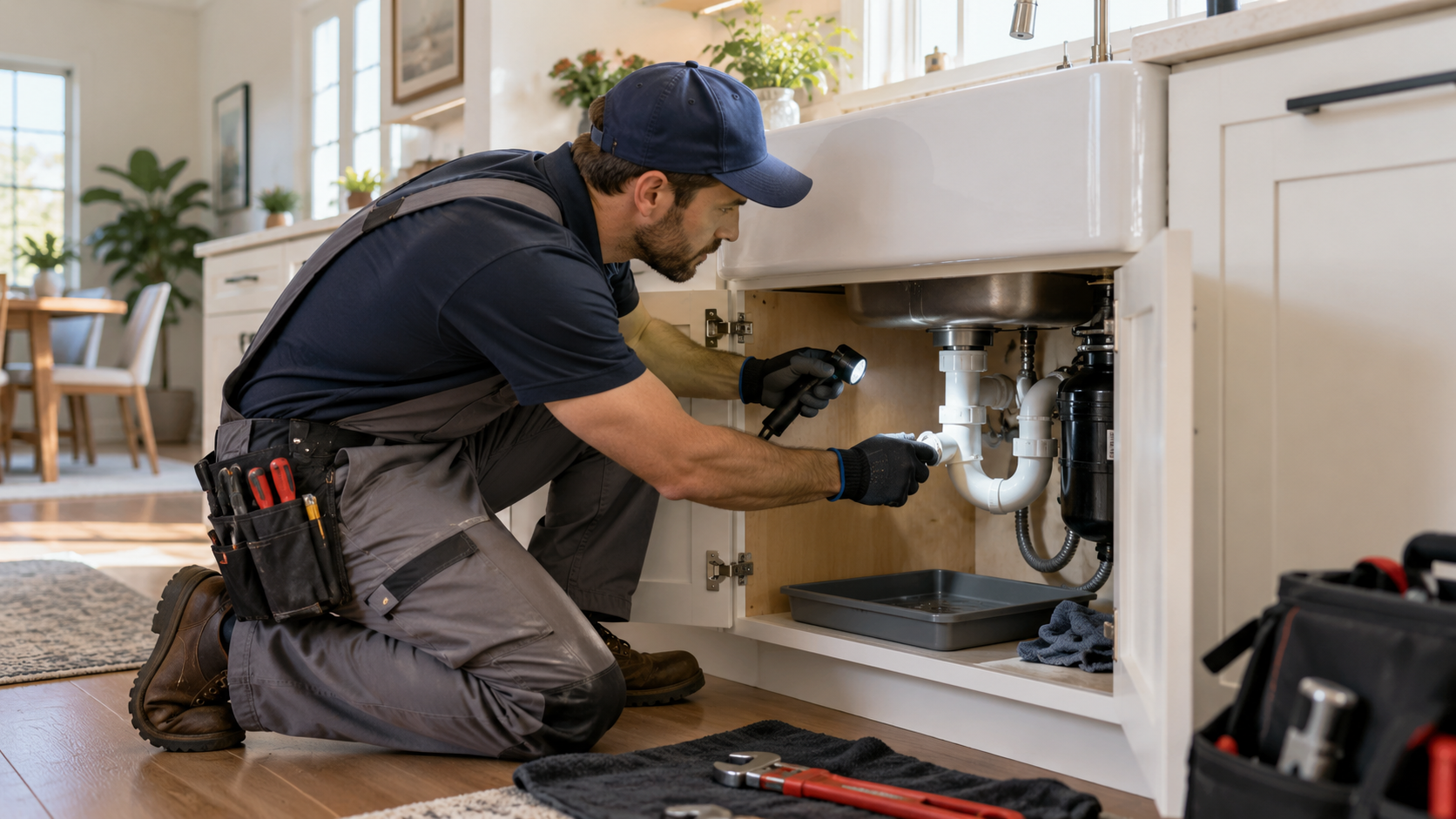
Water leaking under the kitchen sink
The space below a kitchen sink contains more plumbing connections than many homeowners realize.
There may be hot and cold supply lines, shutoff valves, faucet connections, drain pipes, dishwasher hoses, a garbage disposal, and possibly water-filtration equipment.
A small leak can travel along a pipe and drip somewhere far from its actual source.
Dry the area first.
Then run one component at a time.
Turn on the faucet.
Fill and drain the sink.
Run the disposal.
Run the dishwasher only if it is safe to do so.
Watch where moisture first appears.
This simple approach often reveals whether the issue is on the supply side or drain side.
Garbage disposal problems
A disposal that suddenly stops does not always need replacement.
Some units have an overload reset button.
A jam may prevent the motor from turning.
There may also be a power issue.
Never put your hand into a disposal to check for an obstruction.
Disconnect power before any inspection, and follow the manufacturer’s instructions.
If the unit leaks through its housing, makes grinding noises with no obvious obstruction, or repeatedly trips its reset, replacement may make more sense than repair.
Sewer-line trouble can look like ordinary drain trouble at first
A main sewer issue often starts with symptoms that seem small.
One toilet flushes slowly.
A basement drain gurgles.
The shower briefly backs up when the washing machine drains.
Then the symptoms spread.
Warning signs of a possible sewer problem include several slow drains, sewage appearing in the lowest drains, toilets bubbling, recurring blockages, sewer odor, or unexplained wet areas outside along the sewer path.
Tree-root intrusion, pipe collapse, separated joints, grease buildup, foreign objects, and aging pipe materials can all cause sewer trouble.
A sewer camera inspection is often useful when the problem keeps returning.
Tree roots do not attack healthy pipes for fun
Roots seek moisture.
If a sewer pipe has a crack, loose joint, or opening, roots can grow toward the moisture and enter the line.
Once inside, they may trap waste and create recurring blockages.
Mechanical cutting or hydro jetting may clear some roots, but cleaning does not repair the point where they entered.
If the pipe remains damaged, the roots can return.
That is why a post-cleaning camera inspection can be valuable.
Repair or replace? The question behind many plumbing calls
Not every old fixture needs replacement, and not every broken component deserves another repair.
Age, condition, repair history, labor cost, accessibility, and the availability of replacement parts all matter.
| Situation | Repair may make sense | Replacement may make more sense |
|---|---|---|
| Dripping faucet with available parts | Usually | If the fixture is heavily corroded or repeatedly fails |
| Running toilet | Often | If the toilet is cracked or has several aging components |
| Leaking shutoff valve | Often repairable or replaceable individually | Broader replacement if several old valves are failing |
| Single damaged pipe section | Often | If deterioration is widespread |
| Recurring sewer blockage | Cleaning may help | Structural repair if the pipe is cracked, collapsed, or badly offset |
| Old disposal with motor failure | Sometimes | Often, depending on age and repair cost |
| Repeated repairs throughout an aging plumbing system | Possibly in stages | Larger replacement project may offer better long-term value |
The cheapest fix today is not always the cheapest decision over the next few years.
But replacement should not be automatic either.
Ask what failed, what caused the failure, and what condition the surrounding plumbing is in.
How much does plumbing repair cost in the USA?
There is no single reliable price for plumbing repair across the United States.
Labor rates vary by city and state. A repair in Manhattan may be priced very differently from the same job in a small Midwestern town.
The type of repair matters even more.
Replacing a toilet fill valve is not comparable to opening a wall and repairing a leaking supply pipe.
Sewer work is another category entirely.
Emergency scheduling, difficult access, permit requirements, materials, diagnostic equipment, and cleanup can all affect the final bill.
That is why a written estimate is more useful than a random national average.
Ask what the quote includes.
Diagnosis?
Labor?
Parts?
Camera inspection?
Wall opening?
Cleanup?
Permit fees if required?
The details matter.
Why emergency plumbing costs more
A plumbing company that sends someone out late at night, on a weekend, or during a holiday may charge more because emergency staffing costs more.
That does not mean every leak needs a midnight service call.
If you can safely shut off the affected fixture or water supply and prevent damage, some repairs can wait until normal business hours.
But active flooding, sewage backup, gas concerns, major water-heater leaks, or loss of essential water service may justify urgent attention.
What makes a plumbing problem an emergency?
A plumbing emergency is less about inconvenience and more about risk.
Ask yourself three questions.
Is water actively damaging the property?
Is sewage entering the home?
Is there a safety risk?
If the answer is yes, act quickly.
Situations that often deserve urgent service include:
- burst or rapidly leaking supply pipes;
- sewage backing into the home;
- water near electrical equipment or outlets;
- major water-heater leakage;
- suspected gas leak involving gas appliances;
- frozen pipes that have split or begun leaking;
- loss of water service when the cause is inside the home;
- overflow that cannot be stopped with fixture shutoffs.
When electrical systems are involved, do not enter standing water around energized equipment.
Safety comes first.
DIY plumbing repair: where it makes sense
Plenty of homeowners can handle simple plumbing work.
Replacing a faucet aerator, unclogging a trap, changing a toilet flapper, or replacing a showerhead may be reasonable if you understand the steps.
The key is knowing where the job ends.
If a repair requires opening walls, modifying gas lines, working with a main sewer, changing major supply piping, or dealing with unknown structural damage, the risk rises quickly.
Plumbing mistakes have a special talent for looking fine at first.
A connection can remain dry for two days and then begin leaking inside a cabinet.
That is why proper fittings, preparation, tightening, support, and pressure testing matter.
Know the limits of tape and sealants
Plumbing repair sometimes gets reduced online to “put tape on the threads.”
Real connections are more specific than that.
Some threaded fittings require an appropriate thread sealant.
Some compression connections do not.
Some faucet hoses contain washers that create the seal.
Drain slip joints have their own washers and assembly direction.
Applying sealant where it does not belong can actually make a connection worse.
The fitting design determines the repair method.
Why plumbing codes matter
Plumbing is regulated because poor installations can affect drinking water, sanitation, fire safety, property, and public sewer systems.
Local requirements vary across the United States.
Some repairs and replacements may require permits or inspections, especially when work changes major piping, water heaters, sewer connections, or other permanent systems.
A licensed plumber working in your area should understand the local requirements.
If a project is larger than a basic fixture repair, ask whether a permit is required.
Older homes bring their own plumbing surprises
An older house can contain decades of repairs and remodeling behind the walls.
You may find copper connected to newer PEX.
Old galvanized supply lines may remain in one part of the home while another section has been updated.
Cast-iron drain lines can be present alongside PVC repairs.
And sometimes a previous homeowner got creative.
That last category is where things become interesting.
If a repair exposes unusual transitions, unsupported piping, corrosion, or questionable previous work, fixing the immediate leak may only be part of the job.
Water hammer and banging pipes
Do your pipes bang when a washing machine or dishwasher shuts off?
That sudden noise may be water hammer.
When flowing water stops quickly, pressure changes can create a shock wave in the piping.
Loose pipes can also knock against framing and make similar sounds.
The solution depends on the cause.
Pressure problems, fast-closing valves, missing or failed arrestors, and poor pipe support can all contribute.
Persistent banging is worth checking, especially if the plumbing system has high pressure.
Why a faucet may spit air
A little air after plumbing work is often temporary.
But recurring air or sputtering can point to other issues depending on whether the home is connected to municipal water or a private well.
Well systems add another layer because pumps, pressure tanks, and well components can affect flow.
If air continues appearing with pressure changes or unusual pump behavior, the water-supply system may need inspection.
Plumbing repair in a house with a private well
Homes on private wells have plumbing components that city-water homes do not.
A pressure tank helps regulate water pressure.
A pump moves water from the well.
Pressure switches and controls affect operation.
Low pressure or cycling problems may not originate in the house plumbing at all.
They can involve the well system.
If the pump repeatedly turns on and off, pressure swings dramatically, or water supply becomes unreliable, a plumber or well specialist may need to investigate.
Sump pumps deserve attention before the storm
In many U.S. homes with basements or crawl spaces, a sump pump helps remove groundwater before it floods the building.
You do not want to discover that the pump failed during a major rainstorm.
Check that the discharge route is clear and that the float can move freely.
Some homeowners add battery backup systems because a power outage during heavy weather can disable a standard electric pump at exactly the wrong moment.
If the pump runs constantly, makes unusual noises, or fails to start, have it checked.
Preventive plumbing care is mostly about noticing changes
You do not need a complicated monthly plumbing ritual.
A lot of prevention is simply paying attention.
Look under sinks once in a while.
Notice whether toilets begin running.
Do not ignore a valve that starts dripping.
Watch for new stains near bathrooms.
Listen when drains start gurgling.
Know where your shutoffs are.
And deal with recurring problems instead of repeatedly clearing the symptom.
Early repairs are often simpler repairs.
What not to put down household drains
Drain systems handle wastewater. They are not garbage chutes.
Cooking grease is one of the classic troublemakers because it can cool and stick inside pipes.
So-called flushable wipes can also create problems because they may not break down as quickly as toilet paper.
Paper towels, hygiene products, dental floss, cat litter, and similar materials do not belong in toilets.
Kitchen disposals help with small food residue, but they are not designed to grind unlimited amounts of fibrous, greasy, or hard material.
A little restraint at the drain can save a lot of plumbing work later.
How to choose a plumber
For larger plumbing repair, the company matters almost as much as the repair itself.
Licensing requirements vary by state and locality, so confirm what applies where you live.
Insurance is important too.
Ask whether the plumber regularly performs the type of work you need.
A company focused on sewer repair may have different equipment from someone who mainly handles fixture work and remodels.
For a larger job, ask for a clear written estimate.
A professional should be able to explain the problem without burying you in technical jargon.
Questions worth asking before approving plumbing repair
You do not need to interrogate the plumber. A few basic questions are enough.
What caused the problem?
Is this a local failure or a sign of a larger issue?
Can it be repaired, or is replacement more sensible?
What does the quoted price include?
Will the work require opening a wall or floor?
Is a permit required?
Is there a warranty on the repair?
These questions help you understand what you are actually paying for.
FAQ about plumbing repair
What are the most common plumbing repairs?
Common residential repairs include dripping faucets, running toilets, clogged drains, leaking supply lines, failed shutoff valves, garbage-disposal problems, low water pressure, water-heater connection leaks, and sewer blockages.
How do I know if a plumbing leak is serious?
Active flooding, rapidly spreading water, leaks near electrical equipment, water coming through ceilings, or a leak that cannot be isolated with a fixture shutoff should be treated urgently. Small drips still deserve repair, but they may not require emergency service.
Can I repair plumbing myself?
Some basic jobs can be suitable for homeowners, such as replacing a faucet aerator, toilet flapper, or simple fixture component. Work involving gas, major piping, sewer lines, concealed leaks, or unfamiliar connections is usually better handled by a qualified plumber.
Why does the same drain keep clogging?
The blockage may not be fully removed, or there may be heavy buildup, root intrusion, a damaged pipe, poor slope, or another issue farther downstream. Repeated clogs are a good reason to consider professional drain inspection rather than clearing the same symptom over and over.
How much does plumbing repair cost in the USA?
There is no single national price. Costs depend on the repair type, local labor rates, access, materials, emergency timing, permits, and whether specialized equipment is needed. A written local estimate is more useful than a broad internet average.
When should I call an emergency plumber?
Call for urgent help when there is uncontrolled water flow, sewage entering the home, a burst pipe, serious water-heater leakage, water near electrical systems, or another condition that threatens health or property. If you can safely shut off the water, do so while arranging service.
How can I prevent expensive plumbing repairs?
Repair small leaks early, avoid putting grease and inappropriate materials down drains, watch for recurring clogs, know where the main shutoff is, protect vulnerable pipes from freezing, and pay attention to new sounds, odors, pressure changes, or moisture.
Conclusion: plumbing repair is easier when you catch the problem early
Most plumbing disasters do not start as disasters.
They start as little clues.
A faucet drips.
A toilet runs a bit longer than usual.
A cabinet smells damp.
The shower drain takes an extra minute to empty.
A pipe knocks when the washing machine stops filling.
None of those things feels dramatic.
And that is exactly why people put them off.
Sometimes nothing terrible happens.
Sometimes the tiny leak under the sink slowly damages the cabinet floor.
Sometimes the recurring toilet clog turns out to be a sewer-line problem.
Sometimes that faint water stain grows into a section of damaged ceiling.
Plumbing repair is usually cheaper and simpler when the problem is still small.
That does not mean calling a plumber every time a faucet makes a strange sound.
Homeowners can do basic detective work.
Look for the source.
Check whether one fixture or several fixtures are affected.
Notice whether the problem occurs only when a particular appliance runs.
Check for visible corrosion, moisture, loose connections, or unusual pressure.
Those observations can tell you a surprising amount.
They also help the plumber.
“There is a leak somewhere” is useful.
“Water appears under the sink only when the dishwasher drains” is much better.
The same goes for clogged drains.
If one bathroom sink is slow, the problem may be local.
If the toilet bubbles whenever the washing machine drains and the basement floor drain backs up, that points in a different direction.
Patterns matter.
Another thing worth remembering is that plumbing repair is not always about replacing parts.
Sometimes the best repair is cleaning.
Sometimes it is tightening or resealing the correct connection.
Sometimes it is replacing one failed valve.
Sometimes it means opening a wall and replacing a damaged pipe section.
And yes, sometimes the entire fixture or line has simply reached the point where replacement makes more sense.
The decision should follow the diagnosis.
Not the other way around.
This is especially important with older homes.
Replacing one visibly corroded pipe section may fix today’s leak.
But if the same piping material throughout the house is deteriorating, you may need to think beyond that single spot.
That does not automatically mean repiping the entire house tomorrow.
It means asking the right question: is this an isolated failure or part of a pattern?
The answer can change how you spend money.
Homeowners should also stop feeling awkward about asking plumbers to explain things.
You do not need to understand every fitting name.
You just need to understand the basic problem.
Where is the leak?
Why did it happen?
What is being repaired?
What happens if you leave it alone?
Is this likely to happen again?
A good professional should be able to answer those questions in normal English.
If the explanation is little more than “you need all this replaced,” ask for more detail.
Likewise, be careful with quick fixes that sound too easy.
Plumbing tape is not magic.
Drain chemicals are not magic.
A plunger is not magic.
And a brand-new fixture does not fix a damaged pipe hidden behind it.
The repair has to match the failure.
There is also a financial side to this.
Homeowners often search for a national plumbing repair price and get wildly different numbers.
That is normal.
A plumber replacing a simple valve in an accessible cabinet is doing a very different job from someone locating a leak under a slab.
Location matters.
Access matters.
Materials matter.
Emergency timing matters.
The state of the surrounding plumbing matters.
So rather than focusing only on the headline number, compare what is included.
One estimate may look cheaper because it excludes wall repair, camera inspection, disposal fees, or a second service step.
Another may include those things.
You are comparing work, not just numbers.
And then there is the simplest money-saving move of all: know how to stop the water.
A main shutoff valve is not glamorous.
It may sit untouched for years.
But if a washing-machine hose breaks, a toilet supply line splits, or a pipe bursts, that valve suddenly becomes one of the most valuable things in the house.
Find it now.
Show other adults in the home where it is.
Make sure it works.
You do not need to wait for an emergency to learn your own plumbing system.
The same goes for fixture shutoffs.
Many toilets and sinks have local valves.
If a toilet supply line leaks, you may be able to isolate that one fixture instead of shutting water off to the entire house.
Small bits of knowledge buy you time.
One more thing homeowners often overlook: water damage and plumbing repair are not always the same job.
A plumber may stop the leak.
But soaked drywall, flooring, cabinetry, insulation, or framing may need separate drying or restoration.
If a significant amount of water has escaped, do not assume the problem ends when the pipe stops dripping.
Moist materials need to dry properly.
This matters even more when water has been sitting for a while.
Sewage backups are another category entirely because sanitation becomes part of the problem.
Do not casually clean a major sewage spill like ordinary sink water.
Professional cleanup may be appropriate.
For routine repairs, though, the story is usually much less dramatic.
A valve fails.
A gasket wears out.
A drain gets clogged.
A fixture ages.
Something gets repaired, and life goes back to normal.
That is the goal.
Plumbing should be boring.
You should turn on a faucet and get water.
You should flush a toilet and forget about it.
You should take a shower without wondering what the ceiling downstairs is doing.
Good plumbing repair gets the house back to that boring, predictable state.
So pay attention to changes.
Fix small leaks before they become big ones.
Do not ignore recurring clogs.
Know your shutoffs.
Keep inappropriate materials out of drains.
And call a professional when the job moves beyond what you can confidently and safely handle.
You do not need to become an expert plumber.
You just need to recognize when your house is trying to tell you something.
It usually starts quietly.
Leave a Reply