
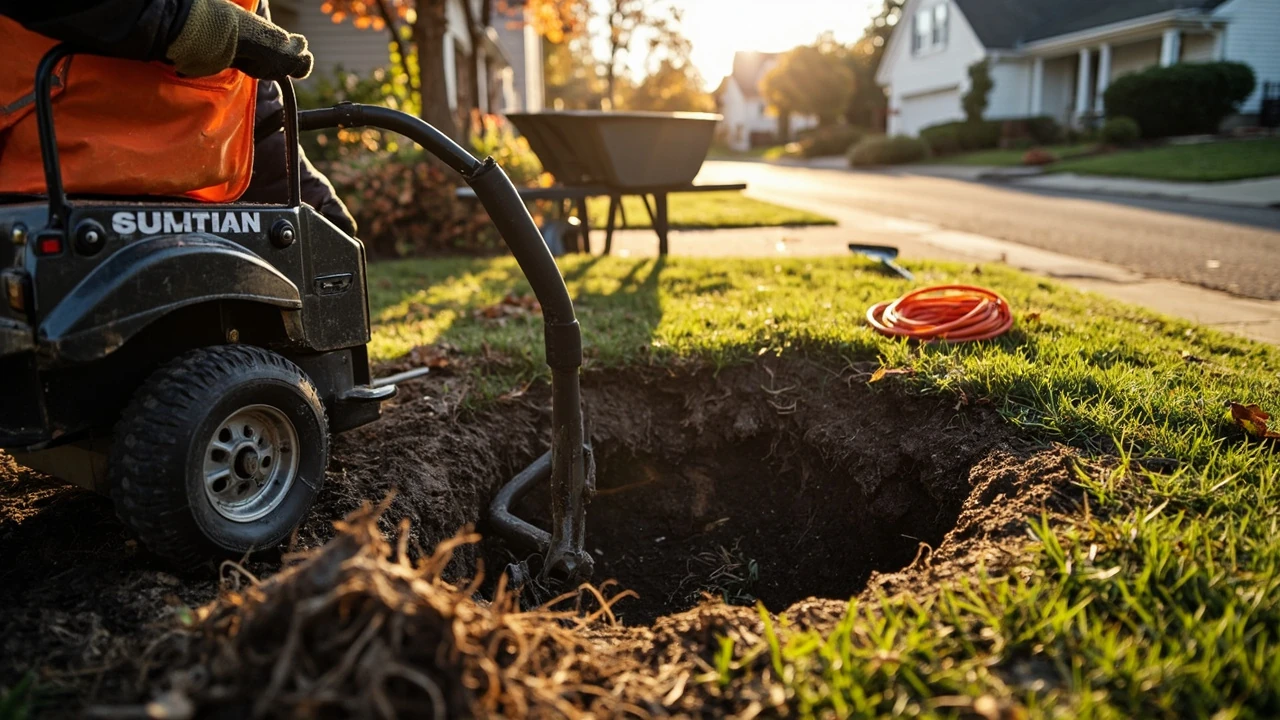
Stump removal: what it really involves and when it is the right choice
A freshly cut oak sits in the front corner of a yard, and the homeowner is now staring at a low, woody disc surrounded by a halo of soil. The tree is gone, but the question that follows is rarely simple: should the leftover stump be pulled out of the ground, ground down into chips, or simply left in place? Among those choices, full stump removal is the most intrusive option, and it is the one most often misunderstood. It is not a single tool or a single price tag. It is a sequence of decisions about depth, roots, soil, backfill, and what the ground will be used for next.
For U.S. homeowners, stump removal usually comes up after a tree has already been felled, often by a separate tree service. The visible stump is the part of the trunk that remains at ground level, and beneath it is a root plate that can spread several times the width of the canopy. What looks like a small flat disc on the surface is, in reality, the top of a buried system that can be surprisingly heavy, surprisingly wide, and surprisingly stubborn. The job of stump removal is to lift that whole mass out of the ground, not just shave the top.
This guide walks through how full stump removal actually works, how it differs from grinding, what drives the cost, when it is genuinely worth the effort, and when a homeowner is usually better off choosing a less aggressive approach. The goal is practical clarity, not a sales pitch for any particular method.
What stump removal actually means
In plain terms, stump removal is the process of extracting the entire stump and the main root mass from the ground, leaving a hole where the tree once stood. It is different from stump grinding, which uses a high-speed wheel to shred the visible stump into woodchips while leaving the root system behind to decay on its own. Both terms show up in contractor quotes and DIY blog posts, and they are often used interchangeably by people who have never done the work. They are not the same job.
Full removal can be done in several ways:
- Mechanical pulling with a machine that hooks the stump and lifts it out of the soil.
- Excavation with a backhoe or mini-excavator, where the operator digs around the stump, severs the major roots, and hoists the stump out.
- Manual digging with mattocks, digging bars, reciprocating saws, and chain saws, usually for small stumps in soft soil.
- Chemical acceleration, where the stump is treated with a high-nitrogen product to speed up decay before mechanical work, often over many months.
Each method produces the same end result, an empty hole, but the equipment, labor, timeline, and disturbance to the surrounding yard vary widely. A homeowner who understands the basic vocabulary can read quotes more confidently and avoid paying for one method while getting another.
Stump removal versus stump grinding
The comparison between full removal and grinding is the most common decision point for homeowners after a tree comes down. The two methods solve different problems, and the right answer depends on what the yard needs to do next.
| Factor | Stump removal | Stump grinding |
|---|---|---|
| What is taken out | The full stump and main root mass | The visible stump, ground to a depth of roughly 6 to 12 inches |
| Roots left behind | Few, mainly fine feeder roots | The entire root system, which can extend 4 to 12 feet beyond the stump |
| Visible result | A hole that needs backfill and sometimes topsoil | A mound of woodchips that compost down over months |
| Disturbance to lawn | Higher, especially around the root plate | Lower, usually limited to a small work area |
| Best fit for | New planting, building projects, full replanning of an area | Lawn recovery, quick cosmetic cleanup, low-impact sites |
| Time on site | Often half a day to a full day per large stump | Often under an hour for an average stump |
| Long-term decay issues | Few, since the mass is gone | Roots can take a decade or longer to break down |
A useful way to think about the difference is that grinding is a surface solution and removal is a structural one. If a homeowner plans to pour a small concrete pad, install a shed, plant a new tree in the same spot, or rework grading in the area, the leftover root mass from grinding can be a real obstacle. If the only goal is to stop mowing around the stump and let grass grow back, grinding is often enough.
Why homeowners choose full removal
Most decisions to remove a stump completely are not aesthetic. They come from a practical problem the stump is creating, or about to create, in the yard.
- Replanting in the same spot. Many species, including oaks, maples, and several fruit trees, release chemicals or host soil fungi that suppress new growth of the same species. Removing the old root mass and replacing some of the soil gives a new tree a much better start.
- Construction or hardscape plans. A shed base, a small patio extension, a fence post hole, a walkway, or a play structure all need clear, root-free ground. Cutting through old roots with a shovel after a grind is a frustrating experience, and a full extraction avoids it.
- Lawn equipment safety. Even a low stump that has been ground down can leave a hardened core that dulls mower blades and trips wheels. A full removal eliminates the risk.
- Pest and disease concerns. Decaying stumps can attract carpenter ants, termites, and wood-boring beetles. In warmer parts of the U.S., this is a real consideration, especially near wooden siding or a wooden shed.
- Regrading or drainage work. If a yard is being regraded, a buried stump can interfere with new soil contours and even with shallow utility lines that are being added.
For some homeowners, the choice is also about resale. A yard with a clearly visible hole that has been filled, leveled, and reseeded reads as “finished” in a way that a low mound of chips slowly composting does not.
How a professional stump removal usually unfolds
A well-run stump removal is more orderly than it looks from the street. Knowing the steps helps a homeowner judge whether a quote covers the full job or just the first half of it.
- Site walkthrough. The contractor looks for underground utilities, irrigation lines, invisible fences, and any nearby structures. A quick call to the local 811 service in the U.S. marks buried lines before any digging starts.
- Protection of the work area. Plywood sheets are often laid down so heavy equipment does not tear up the surrounding lawn. This is a small detail that separates careful operators from careless ones.
- Loosening the root plate. Depending on the size of the stump, the operator uses a stump grinder to sever the lateral roots, a backhoe to dig around the root plate, or a pulling machine to grip and lift the stump. On a small yard job, a lot of this work is still done with a digging bar and a chain saw.
- Lifting the stump. The stump and attached root mass are pulled free. A single oak stump with a wide root plate can weigh several hundred pounds and may need a small machine to lift cleanly.
- Backfilling the hole. The cavity is filled with a mix of the original soil and, in many cases, additional topsoil. Some contractors compact in layers; others leave the fill slightly mounded to account for settling.
- Cleanup and surface restoration. Soil is raked smooth, wood and root debris are hauled away or stacked for the homeowner, and the area is either left ready for seeding or for whatever project is coming next.
A clear, written quote should describe each of these steps, even briefly. If a contractor only mentions “pulling the stump” without describing what happens to the hole afterward, that is a fair place to ask follow-up questions.
What affects the cost of stump removal
Stump removal pricing in the U.S. varies widely because the inputs vary widely. Three stumps in the same yard can carry three different prices once the variables are sorted out.
| Cost factor | Why it matters | Typical effect on price |
|---|---|---|
| Stump diameter | Larger stumps have wider, heavier root plates | Price climbs steeply once diameter passes roughly 18 to 24 inches |
| Species | Hardwoods like oak and hickory have dense, deep roots; softwoods like pine have shallower, easier systems | Hardwoods usually cost more per inch of diameter |
| Root depth and spread | Older trees develop wider lateral roots, sometimes 4 to 12 feet past the trunk | Wider root systems mean more digging and more time |
| Soil type | Clay holds onto roots and tools; sandy loam releases them more easily | Clay and rocky soil raise labor time and wear on equipment |
| Access for equipment | A backyard stump with no side gate access is far harder to reach than a front-yard stump | Limited access can add a manual labor surcharge or require smaller equipment |
| Number of stumps | Most contractors price per stump but discount the second, third, and fourth | Multi-stump jobs usually lower the per-stump price |
| Backfill and restoration | Filling the hole, hauling chips, and reseeding are sometimes quoted separately | These add-ons can add a meaningful percentage to the total |
Without current local quotes, it is more useful to focus on the factors than on a single number. A homeowner who understands why their stump is harder than a neighbor’s is in a much better position to evaluate the bids they receive.
DIY stump removal: when it makes sense and when it does not
There is a long tradition of homeowners tackling their own stumps, and there are situations where that is reasonable. The decision turns on three things: the size of the stump, the soil, and the homeowner’s tolerance for physical work.
For For additional context, stumps under about 10 inches in diameter, in soft soil, with no nearby utilities, a patient homeowner can usually do the job over a weekend with a chain saw, a mattock, a digging bar, a reciprocating saw with a long blade, and a good wheelbarrow. The process is essentially the one a contractor would follow, just slower and louder. It is honest work, and it is also the kind of project that tends to take two to three times as long as planned.
DIY stump removal is usually a poor fit when:
- The stump is over about 18 inches in diameter.
- The tree was a mature hardwood with a wide root plate.
- The yard is full of buried utilities, irrigation lines, or invisible fences.
- The homeowner does not have, or cannot rent, a chain saw, a heavy digging bar, and a way to haul several hundred pounds of wood and root.
- The hole will need to be backfilled and finished cleanly, with no settling, for a new lawn or a small structure.
There is also a safety point that often gets lost in DIY enthusiasm. A buried root ball can shift unexpectedly when cut, and a chain saw in the dirt is a real hazard. Renting a small stump grinder is often a better DIY compromise than trying to dig out a large stump by hand.
Tools professionals rely on for stump removal
A good stump removal crew shows up with a recognizable set of tools. Knowing what they are helps a homeowner understand what they are paying for and what “extra equipment” charges actually refer to.
- Stump grinder. A walk-behind machine with a vertically spinning wheel studded with carbide teeth. Used to sever lateral roots before pulling, or to grind below grade after pulling.
- Compact track loader or skid steer. Used to lift the stump out of the ground once the roots are cut, and to move backfill material efficiently.
- Mini-excavator. Useful on large stumps or in tight access situations where a backhoe is too big.
- Hand tools. Mattocks, digging bars, pruning saws, and reciprocating saws for the detail work no machine can do well.
- Compaction equipment. A plate compactor or hand tamper to settle backfill so the surface does not sink later.
- Utility locating tools. Private locators supplement the public 811 marks for irrigation and low-voltage lines that 811 does not cover.
A crew that arrives with a pickup truck and a small grinder, with no plan for lifting a heavy root ball, may be set up to grind, not to remove. That is not necessarily a problem if the homeowner actually wants a grind, but the two services are priced and scoped differently.
After the stump is out: filling the hole correctly
A clean stump removal is only half the job. The hole left behind is often larger than the homeowner expects, and how it is filled determines whether the spot blends back into the lawn or becomes a small depression that catches water and collects leaves.
A practical backfill sequence looks like this:
- Break up the exposed subsoil at the bottom of the hole with a digging fork so the new fill does not sit on a hard pan.
- Place the largest root pieces and chunks of stump wood at the bottom of the hole, where they can decompose in air without affecting the surface.
- Add soil in loose layers of roughly 4 to 6 inches, watering lightly and tamping each layer.
- Leave the final surface slightly mounded, about an inch above the surrounding grade, to account for settling over the next few months.
- Top with screened topsoil if the area is going to be reseeded, and rake to a smooth finish.
If the area is going to be paved or built on, the backfill should be compacted more thoroughly, sometimes with a plate compactor, and a layer of crushed stone may be added beneath the surface to support the new structure. This is where it pays to know, before the stump comes out, what the ground will be used for next.
Safety, utilities, and permits
Stump removal is real excavation, and it touches the same regulations that govern other digging on a residential lot. A few points are worth flagging.
- Call before you dig. In the U.S., the 811 service coordinates utility marking for gas, water, electric, telecom, and sewer laterals. It is free, and the marks are valid for a limited window, so the timing of the call matters.
- Private lines. Irrigation, landscape lighting, and invisible dog fences are not marked by 811. A homeowner who has these should mark them or have a private locator come in.
- Local rules. Some municipalities require permits for stump removal, especially if the work involves a backhoe on a public right-of-way or impacts a protected tree’s replacement. A quick check with the local building or public works department can prevent a stop-work order.
- Personal protection. Eye and hearing protection, gloves, and steel-toe boots are the minimum. A chain saw cutting roots near dirt is one of the most common ways homeowners injure themselves during this kind of work.
A reputable contractor will handle most of this by default. If a quote comes in unusually low, it is reasonable to ask how utility locates and site protection are being handled.
Common mistakes homeowners make with stump removal
Most stump removal problems are not technical. They are sequencing and expectation problems that show up weeks after the crew has left.
- Choosing removal when grinding would do. Paying for a full extraction and a large hole repair, only to seed grass over the spot, is more work and more disturbance than the yard needs.
- Choosing grinding when removal was needed. The opposite error: a homeowner grinds a small stump and then discovers, while digging post holes for a new fence, that the old root mass is still in the way.
- Filling the hole with chips only. Wood chips break down and the surface sinks. The fill should be mostly soil, with chips only as a minor component or as surface mulch.
- Skipping compaction. A hole filled loosely will settle unevenly, often creating a low spot that kills new grass and collects water.
- Planting the wrong replacement. A removed stump in heavy clay can leave a pocket of poor soil. A new tree planted directly in the same spot without amending the soil often struggles for the first few years.
None of these are disasters. They are the kind of small mistakes that add cost or delay to a project that is otherwise straightforward. A short planning conversation before the work starts usually prevents all of them.
How stump removal fits into a larger yard project
Stump removal is rarely the whole project. It is almost always one step in something larger, and the larger project usually dictates the right approach.
For a full yard renovation that includes regrading, new irrigation, and new planting beds, full removal makes sense because the soil will be worked deeply anyway. For a simple lawn repair after a single tree has come down, grinding is often the right balance of cost and disturbance. For a new shed, patio, or detached garage, full removal is almost always required, because the slab or footings need to bear on soil that is not full of decomposing wood.
Homeowners who are planning several projects at once can sometimes save money by bundling stump work with other excavation, since the equipment is already on site. A short conversation with a landscape contractor or a general contractor can turn two separate mobilizations into one.
If a project will involve any of the household systems that plumbing repair work covers, such as rerouting a sewer line or a downspout drain through the same area, coordinating the stump removal with that work avoids the awkward situation of refilling a hole that has to be reopened a few weeks later.
Frequently asked questions
How long does stump removal take for a typical residential stump?
For a stump in the 12 to 24 inch range, a professional crew with the right equipment can usually complete the full removal, including backfill, in half a day to a full day. Larger stumps or stumps with difficult access can take longer. A clean, organized site also affects how long the work takes, which is one reason contractors sometimes lay plywood to protect the lawn before bringing equipment in.
Can I plant a new tree in the same spot after stump removal?
Yes, but with a few conditions. The old root mass should be removed as completely as practical, the backfill should include fresh topsoil rather than only the original subsoil, and it is wise to avoid replanting the same species in the exact same spot for a season or two. Soil-borne fungi and residual chemicals from the old root system can slow the growth of a replacement of the same species. Choosing a different species, or waiting and amending the soil in the meantime, usually gives better results.
Is stump removal covered by homeowners insurance?
It depends on why the tree came down. If the tree fell because of a covered event such as a storm, and the stump is part of the cleanup, some policies will cover a portion of the cost. If the tree was removed for routine reasons such as disease or landscape planning, stump removal is generally considered home maintenance and is not covered. Reading the specific policy language, or calling the insurer, is the only reliable way to find out.
What happens to the wood and roots after stump removal?
That depends on the contractor and on the homeowner. Some crews haul everything away. Others stack the larger pieces for the homeowner to use as firewood or to dispose of, and remove the rest. The wood from a removed stump is real, usable firewood in most cases, though it should be seasoned like any other hardwood before burning.
How deep does stump removal go?
A full stump removal typically goes deep enough to extract the root plate, which is usually the top 12 to 24 inches of the root system, depending on the species. Feeder roots below that depth are generally cut and left in the ground, where they break down over time. The point of full removal is not to remove every trace of root, but to remove the structural mass that would interfere with replanting or construction.
Can stump removal damage nearby structures or utilities?
It can if the work is done without utility locates or without care around foundations, fences, and walkways. This is one of the reasons professional contractors call 811 before starting and lay protection on the lawn. A homeowner doing the work themselves should mark all known lines and check for unknown ones before digging.
Is it better to grind a stump or remove it if I plan to sell my house?
For most listings, either method is acceptable as long as the result looks intentional. A clean grind with a neat layer of chips reads as “handled” to most buyers. A clean removal with a properly backfilled, reseeded lawn also reads as “handled.” What buyers tend to react to is the in-between state: a low mound of chips that has not been smoothed, or a sunken hole that has not been filled. Whichever method is chosen, finishing the surface well matters more than the method itself.
Do stumps attract termites everywhere in the U.S.?
Termite pressure varies significantly by region. In the southeastern U.S., the Gulf Coast, and parts of California, the risk that a decaying stump will attract subterranean termites is real and is one of the more common arguments for full removal. In colder or drier regions, the risk is lower. Local pest control operators are a better source for region-specific guidance than any general article.
Can I speed up stump removal with chemicals?
High-nitrogen products are often used to accelerate the decay of a stump that is going to be ground or burned later, but they are slow. Even with treatment, the process usually takes many months, and the stump still needs to be removed mechanically once it has softened. For most homeowners, chemical acceleration is a last resort for stumps in awkward locations, not a substitute for a real removal plan.
How do I choose between stump removal quotes that look very different?
Look past the headline number and check that each quote is describing the same scope. One contractor may be quoting a grind, another a full removal, and a third a removal with backfill and reseeding. Ask each one to specify the diameter range, the number of stumps, the access situation, whether backfill is included, and whether debris haul-off is included. Once the scopes line up, the price differences usually make sense, and the lowest quote that fully covers the scope is usually the best one.
Putting it into a plan
A short planning step before the work starts is usually the difference between a stump removal that disappears into the yard and one that lingers as a small problem. A practical checklist for most homeowners looks like this:
- Confirm what the ground will be used for next: lawn, planting, hardscape, or a new structure.
- Decide between full removal and grinding based on that future use, not on price alone.
- Get at least two written quotes that describe method, scope, backfill, and cleanup.
- Confirm utility locates and any local permit requirements before the crew arrives.
- Plan the backfill in advance, including topsoil and seed or sod, so the surface is finished the same day.
Stump removal is one of the more satisfying jobs in residential landscaping because the result is immediate and the spot is usually usable again within a season. With a clear plan, the right method, and realistic expectations about cost and disturbance, it is also one of the more straightforward projects a homeowner can take on, either as a standalone job or as the first step in a larger yard project. As For additional context, a Davey tree care overview on stump removal versus grinding puts it, the choice really does come down to what the landscape needs to do next, and that is a decision worth making before any equipment rolls onto the lawn.
Leave a Reply