
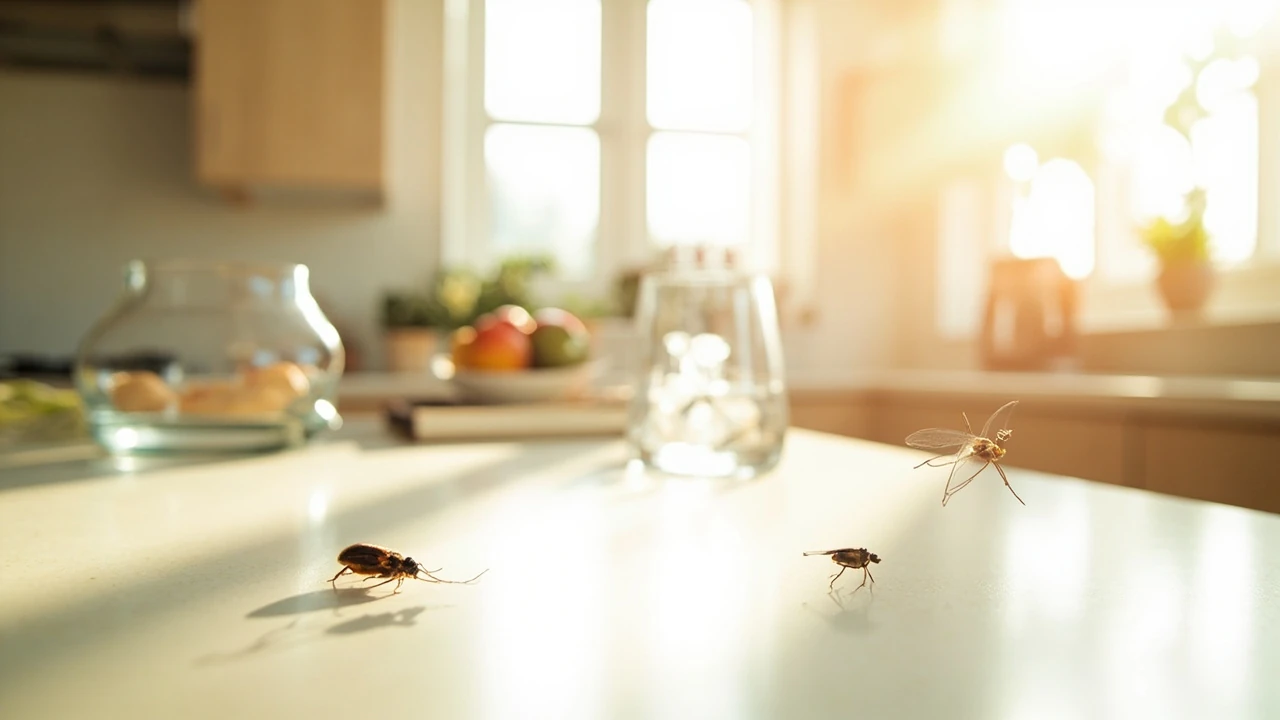
Fleas vs gnats: how to tell them apart in and around your home
A small dark speck jumps off the dog’s back and disappears into the carpet. A few hours later, something nearly as small is hovering over the kitchen sink. The two insects look almost identical at a glance, yet they behave so differently that the wrong treatment can waste weeks of effort. Sorting out fleas vs gnats is one of the most common pest calls in U.S. homes because both pests are tiny, both can appear suddenly, and both tend to multiply faster than people expect.
This guide is written for homeowners, renters, and pet owners who want a practical way to tell which pest they are actually dealing with, what the infestation is telling them, and what to do next. It compares the two insects across size, movement, habitat, health risks, and the signs each one leaves in a home, then walks through identification, treatment, and prevention in plain language.
Why the confusion happens in the first place
Both fleas and gnats are small enough that most people never see their bodies in detail. Both are usually brown or black. Both seem to come out of nowhere. The similarities end there, and that is exactly why the comparison matters. A flea is a wingless parasite that feeds on blood; a gnat is a flying insect that feeds on organic decay, moisture, or in some species, skin. Treating a carpet for a gnat problem or pouring drain cleaner on a flea infestation both fail because they target the wrong biology.
Once you can place the insect into one of those two categories, the rest of the decision tree becomes much shorter: where to look, what to clean, and whether a veterinarian, a plumber, or a pest professional is the right call.
Quick comparison: fleas and gnats at a glance
Before walking through the details, it helps to see the differences side by side. The table below summarizes the traits homeowners can check without a microscope or a hand lens. If you can match what you are seeing to even three of these rows, you usually have enough information to choose the right next step.
| Feature | Fleas | Gnats |
|---|---|---|
| Body size | About 1 to 3 mm long | About 1.5 to 6 mm long, depending on species |
| Color | Reddish brown to nearly black | Brown, black, or grayish; some species tan |
| Wings | None; flightless | One pair of clear, delicate wings |
| Movement | Crawls and jumps, often 100 times its body length | Flies in short, hovering patterns; weak fliers |
| Primary food | Blood of mammals and birds | Decaying matter, fungi, plant nectar, or in some species, blood |
| Where you see them | On pets, in pet bedding, carpet fibers, baseboards | Near drains, fruit, trash cans, houseplants, windows |
| Health concerns | Bites, itching, tapeworm, pet anemia, disease transmission | Nuisance, possible food contamination, occasional bites in some species |
| Most common sign at home | Pets scratching, tiny dark specks in fur or carpet | Cluster of small flies in kitchen, bathroom, or near plants |
Use this table as a first pass, not a final answer. A few species of biting gnats do feed on blood, and a heavy flea infestation can produce so much activity that it looks like something is flying. The next sections break down how to confirm what you are seeing.
What a flea actually is and how it behaves
Fleas are wingless parasitic insects in the order Siphonaptera. Adults feed exclusively on the blood of warm-blooded animals, most commonly cats, dogs, rabbits, raccoons, opossums, and rodents. Humans are not their preferred host, but they will bite people when animal hosts are scarce or when infestations are heavy.
The three species that most often show up in U.S. homes are the cat flea, the dog flea, and, less commonly, the human flea. Despite the names, the cat flea accounts for the majority of infestations on both cats and dogs in North America. Adult fleas are about 1 to 3 millimeters long, with hard, laterally compressed bodies that let them slip easily through fur and carpet fibers.
Life cycle and why infestations explode
Fleas go through four stages: egg, larva, pupa, and adult. The entire cycle can complete in as little as two to three weeks under warm, humid indoor conditions, which is why a small problem can become a serious one in a single season.
- Eggs are laid on the host but fall off within hours, ending up in carpet, bedding, and cracks in flooring.
- Larvae feed on adult flea feces and organic debris for 5 to 15 days, then spin a cocoon.
- Pupae can stay dormant for weeks or months, waiting for vibration, warmth, or carbon dioxide that signals a host is near.
- Adults emerge, jump onto a host, and begin feeding within minutes.
This is also why vacuuming, washing bedding, and treating pets at the same time is so important. Treating only the adult fleas on a dog leaves roughly 90 percent of the population untouched, since the eggs, larvae, and pupae live in the environment.
Bites, allergic reactions, and disease risk
Flea bites usually appear as small red dots, often in clusters of three or four, around the ankles, lower legs, waist, or armpits. They itch because the flea injects saliva while feeding. Some people develop flea allergy dermatitis, a hypersensitivity reaction that can cause large, raised welts even from a few bites.
The bigger health concerns come from the parasites fleas can carry. Fleas are intermediate hosts for tapeworms that infect dogs, cats, and occasionally children. They can also transmit bacterial diseases, most notably murine typhus and, in some regions, plague, though household transmission in the U.S. is rare. For pets, a heavy flea load can cause anemia, especially in puppies, kittens, and small breeds.
What a gnat actually is and how it behaves
Gnat is a broad, informal name rather than a single scientific category. In everyday use it covers several families of small flies, including fungus gnats, fruit flies, drain flies, phorid flies, and biting midges. They share little more than their size and a tendency to appear indoors, which is part of what makes identification tricky.
Most gnats are between 1.5 and 6 millimeters long. They are weak fliers, often hovering or drifting rather than zooming across a room. Adult gnats live for about a week, but females can lay hundreds of eggs in that time, which is why a small problem can scale up quickly in the right conditions.
The most common indoor gnat types
Before you treat a gnat problem, it helps to narrow down which type you have. The location where the gnats cluster is usually the strongest clue.
- Fruit flies: Tan or brown, often found near ripening fruit, vegetable bowls, recycling bins, and empty bottles.
- Fungus gnats: Dark and mosquito-like, common in overwatered houseplants and damp potting soil.
- Drain flies: Moth-like, fuzzy, and short, often seen resting on bathroom or kitchen walls near drains.
- Phorid flies: Humpbacked and fast, often associated with plumbing leaks, trash, and decaying matter under floors.
- Biting midges: Tiny and aggressive, usually found near standing water outdoors and in coastal or wet areas.
Health and nuisance concerns
Most indoor gnats do not bite. The bigger concerns are nuisance and contamination. For additional context, Gnats can land on food preparation surfaces, breed in drains, and trigger respiratory irritation in people with allergies to small flying insects. Biting midges are an exception: their bites cause small, painful welts and can spread pathogens in some regions, but they are mostly an outdoor pest in the U.S.
Fleas vs gnats: how to tell them apart in real conditions
Once you know what each insect is, the comparison becomes much easier to apply. The list below pairs each common observation with the pest it points to. Walk through it in order, and you will usually have a confident answer within a few minutes.
- Can you see wings? If yes, it is a gnat. Fleas do not have wings at any life stage.
- Does it jump? If yes, it is almost certainly a flea. Gnats fly but do not jump.
- Where do you see it most? On a pet, in pet bedding, or in carpet fibers points to fleas. Near drains, fruit, trash, or houseplants points to gnats.
- What is the pet doing? Scratching, biting at the tail base, or scooting often signals fleas. Calm pets with a few gnats around are not a flea problem.
- What do the bites look like? Tight clusters of red dots near the ankles and lower legs are typical flea bites. Single, larger welts on exposed skin outdoors are more often biting midges or mosquitoes.
- What is on white paper or socks? Walking across carpet in white socks and finding tiny black specks that smear reddish-brown when wet is the classic flea dirt test. Gnats leave nothing on the floor.
If two or more of those lines point in the same direction, you can treat with confidence. If the picture is mixed, the next section helps you confirm before spending money on the wrong product.
Step-by-step: confirming which pest you have
Identification does not need to be complicated. A few simple tests, done in the right order, are usually enough to remove any doubt. Run through these before you buy any treatment product.
Test 1: the white sock walk
Put on a pair of white athletic socks and walk slowly across the carpet, focusing on edges, baseboards, and areas where pets sleep. If small dark specks appear on the socks and they smear reddish-brown when you add a drop of water, that is flea feces, not dirt. Flea feces is essentially digested blood, which is why the smear test is so reliable.
Test 2: the pet comb check
Use a fine-toothed flea comb on your pet, especially around the base of the tail, the neck, and the belly. Comb onto a damp white paper towel. Fleas and flea dirt will appear as small dark specks. If you catch a moving insect, drop it into a clear container with a lid and watch it. If it jumps rather than flies, you have your answer.
Test 3: the gnat location sweep
Walk through the home and note every room where you see small flying insects. Kitchens and bathrooms with drains almost always point to drain flies, fruit flies, or phorid flies. Living rooms with houseplants point to fungus gnats. Bedrooms and living rooms with pets but no drains often point to fleas. The room-by-room map is usually more useful than the insect itself.
Test 4: the sticky card check
Place yellow sticky cards near suspected hot spots: by a drain, next to a houseplant, on a window ledge, or beside pet bedding. Leave them for 24 to 48 hours. The pattern of where the cards catch insects is a reliable cross-check on the room map. Gnats will show up on cards in the damp and organic areas. Fleas rarely appear on cards, since they jump rather than fly into the air.
Treatment plans that match the pest you actually have
Once you know which pest you are dealing with, the treatment plan becomes more focused. The two plans below cover most homeowner situations. Larger infestations or commercial properties may need professional pest control, but these steps resolve the majority of household cases.
How to get rid of fleas in a home
Flea control is a four-track effort. Skipping any one of them usually means the infestation comes back within a few weeks.
- Treat every pet at the same time. Use a veterinarian-recommended product: topical treatments, oral preventives, or flea shampoos. Do not rely on over-the-counter flea collars alone for an active infestation.
- Wash all pet bedding and removable covers in hot water. A temperature of at least 130 degrees Fahrenheit kills eggs, larvae, and adults.
- Vacuum thoroughly and repeatedly. Focus on carpet edges, baseboards, under furniture, and anywhere pets rest. Empty the vacuum canister or bag into a sealed plastic bag and take it out of the house immediately. Vacuuming also stimulates pupae to hatch, which then come into contact with any residual treatment.
- Apply a targeted indoor treatment. Insect growth regulators, such as methoprene or pyriproxyfen, break the life cycle by preventing larvae from maturing. Adulticides, such as those containing permethrin or bifenthrin, knock down surviving adults. Many effective products combine both.
For severe or persistent infestations, professional pest control is usually the faster and more reliable route. A detailed walkthrough of professional services is beyond the scope of this page, but homeowners can also learn from how other service industries structure their work by reading through what plumbing repair visits actually look like and applying the same expectation-setting to pest control calls.
How to get rid of gnats in a home
Gnat control is mostly about removing the breeding source. Spraying adults without addressing the source only buys a few days of relief.
- Empty and clean drains. Pour a mixture of baking soda followed by white vinegar down kitchen and bathroom drains, then flush with boiling water. Drain flies and phorid flies often breed in the biofilm inside drain pipes.
- Discard overripe produce and seal fruit. Refrigerate ripening fruit, empty trash frequently, and rinse recycling containers before placing them back.
- Adjust watering on houseplants. Let the top inch of soil dry between waterings. For persistent fungus gnats, replace the top layer of soil and use sticky cards to monitor.
- Set up simple traps. A shallow dish of apple cider vinegar with a drop of dish soap attracts fruit flies and drain flies. Commercial sticky traps work well for fungus gnats.
For outdoor biting midges near patios or porches, removing standing water and using box fans to disrupt their weak flight are surprisingly effective first steps.
Common mistakes homeowners make when treating the wrong pest
Most failed pest jobs come from treating symptoms rather than the source. The list below highlights the most common errors, grouped by which pest is usually being misdiagnosed.
Misdiagnosing fleas as gnats
- Spraying flying insecticide in the air when the insects are actually fleas jumping from carpet fibers.
- Treating only the pet and not the home, which leaves eggs and pupae to hatch weeks later.
- Using bug bombs, which rarely reach flea hiding places in carpet and baseboards.
- Assuming indoor-only pets cannot have fleas, when fleas can be carried in on shoes, used furniture, or visiting animals.
Misdiagnosing gnats as fleas
- Applying carpet insecticide to fruit-fly problems, which leaves residue where food is prepared.
- Treating pets for fleas when the issue is a drain fly breeding inside a sink trap.
- Replacing carpets and furniture before checking for plumbing leaks that feed phorid flies.
- Ignoring houseplant watering habits, which is the most common cause of recurring fungus gnat problems.
A good way to avoid these mistakes is to step back and treat the comparison as a decision tree. The first question is always whether the insect flies, jumps, or crawls. The second question is where you see it. Answering those two questions correctly puts you on the right treatment path more than 90 percent of the time.
Prevention: keeping fleas and gnats from coming back
Prevention is different for each pest, because the underlying conditions that attract them are different. The table below summarizes the most effective habits for each, so you can build a routine that addresses both without doubling your workload.
| Prevention habit | Helps with fleas | Helps with gnats |
|---|---|---|
| Year-round flea prevention for pets, prescribed by a vet | Yes | No |
| Weekly vacuuming of carpets and rugs | Yes | No |
| Washing pet bedding weekly in hot water | Yes | No |
| Keeping kitchen counters free of ripe produce | No | Yes |
| Cleaning drains monthly with enzymatic cleaners | No | Yes |
| Letting houseplant soil dry between waterings | No | Yes |
| Sealing trash cans and removing trash frequently | No | Yes |
| Installing screens on windows and doors | Limited | Yes |
Many households benefit from doing both columns at once, especially in spring and early summer when indoor humidity rises and both pests become more active. A short weekly routine is usually enough to keep populations below noticeable levels.
When to call a professional
Some situations are worth handing off to a licensed pest control operator. The thresholds below are a useful guide, though local conditions and tolerance levels vary.
- Flea infestations that persist after two to three weeks of thorough treatment, especially in homes with multiple pets or heavy carpeting.
- Recurring drain fly or phorid fly problems, which can signal a broken drain trap, a cracked pipe, or a sewer line issue that needs plumbing repair.
- Biting midge or mosquito problems around a yard, which often require a more comprehensive outdoor treatment plan. If you want a head start on understanding what a service visit looks like, the approach described in how air conditioner repair services are typically scheduled is a useful parallel for setting expectations on timing, scope, and follow-up.
- Any case where a family member or pet is having a strong reaction to bites, or where there is a sudden unexplained skin rash.
Frequently asked questions
Are fleas and gnats the same insect?
No. Fleas are wingless parasitic insects that feed on blood and move by jumping. Gnats are a loose term for several families of small flying insects, most of which feed on decaying organic matter, fungi, or plant material. The confusion comes from their similar size and color, not from being related.
Can fleas fly or glide?
Fleas cannot fly. They do not have wings at any stage of their life cycle. Their main form of movement is a powerful jump, which can cover around 100 times their body length. That jump can feel like a small insect appearing out of nowhere, which is part of why fleas are sometimes mistaken for gnats.
Do gnats bite humans?
Most indoor gnats do not bite. Fruit flies, fungus gnats, drain flies, and phorid flies are nuisance pests. The main exception is biting midges, which do feed on blood and can deliver small, painful bites, although they are mostly an outdoor pest in the U.S.
How can I tell whether bites are from fleas or gnats?
Flea bites usually appear as small red dots, often in clusters of three or four, around the ankles, lower legs, waist, or armpits. Biting midge bites tend to be single, larger welts on exposed skin and are usually acquired outdoors. If you only have bites indoors and a pet is scratching, fleas are far more likely.
What kills fleas in a house quickly?
The fastest path is treating every pet at the same time with a veterinarian-recommended product, washing all pet bedding in hot water, vacuuming thoroughly, and applying a combination adulticide and insect growth regulator to carpets and baseboards. Skipping any one of those steps usually means fleas return within a few weeks.
What is the fastest way to get rid of gnats indoors?
Identify the breeding source first. For fruit flies, remove ripe produce and clean trash cans. For drain flies, scrub and flush the drains. For fungus gnats, let the soil dry and use sticky cards. Spraying adults only buys a few days unless the breeding site is removed.
Can a home have fleas and gnats at the same time?
Yes. The conditions that attract one pest do not exclude the other. A home with pets, carpets, and overwatered houseplants can easily host both. Treat them as two separate projects with their own timelines, rather than a single combined problem.
Are fleas more dangerous than gnats?
Fleas generally pose a higher health risk because they bite, can cause anemia in pets, and can transmit tapeworms and certain bacterial diseases. Gnats are mostly a nuisance, though drain flies and phorid flies can indicate plumbing or sanitation issues that are worth addressing on their own.
How long does it take to clear a flea infestation?
With thorough treatment, most homes see a major reduction within two to three weeks, and full control within six to eight weeks. Pupae can stay dormant for a long time, so occasional adult fleas may appear for a couple of months even after treatment. Continued vacuuming and pet prevention close the loop.
How do I know if gnats are coming from my drains?
Place a piece of clear tape over the drain overnight, sticky side down. If small flies are stuck to the tape in the morning, the drain is likely a breeding site. Another sign is seeing flies rest on bathroom or kitchen walls near the drain, rather than near windows or plants.
A practical next step
Start with the two most useful tests: the white sock walk and a quick pet comb check. Those two checks will tell you if you are dealing with fleas, gnats, or both, and they cost nothing. From there, build a short routine around the real source of the problem rather than the insects you happen to see first, and revisit the room map if activity returns. Most of the frustration around fleas vs gnats comes from treating the wrong pest; matching the treatment to the source usually clears the issue within a few weeks.
Leave a Reply