
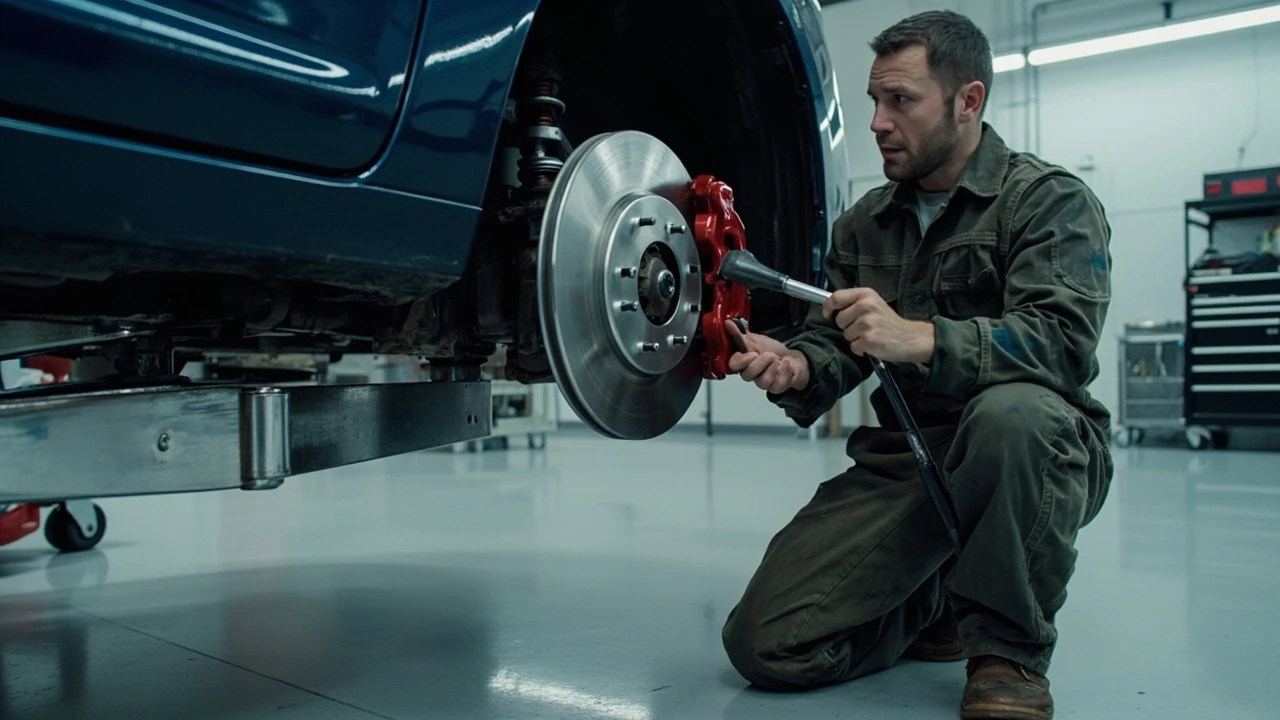
Brakes service: what a complete job actually includes
A driver presses the brake pedal more than a thousand times on a typical commute, so it is no surprise that the parts doing the slowing eventually wear out. A brakes service is the set of inspections, measurements, and part replacements that keep a vehicle able to stop predictably. The challenge for most drivers is not finding a shop that will say yes to the work; it is judging whether the recommended service matches the actual condition of the vehicle and whether the parts being installed are the right ones for the way the car is driven.
This guide walks through what a proper brakes service looks like, from the first warning signs a driver notices, to the components a technician should measure, to the questions worth asking before approving any repair. The goal is to give a non-mechanic enough context to evaluate the work, not to turn anyone into a brake technician.
How a braking system actually slows a car
Modern passenger vehicles use hydraulic disc brakes on the front wheels and either disc or drum brakes on the rear wheels. Pressing the pedal sends brake fluid through hard lines and flexible hoses to calipers at each wheel. The calipers squeeze friction material called brake pads against a spinning metal rotor. The friction converts the car’s forward motion into heat, which dissipates into the air, and the car slows down.
Each wheel assembly includes a few parts that wear at different rates and in different ways. Knowing which part is which makes it easier to follow a technician’s recommendations.
- Brake pads are the friction material that presses against the rotor. They are designed to wear out before the rotor does, because pads are cheaper and easier to replace.
- Brake rotors are the machined metal discs the pads clamp onto. They wear more slowly but can warp, crack, or become too thin to reuse.
- Brake calipers house the pistons and pads. They slide on pins or fixed mounting points and can seize, leak, or develop a sticky piston.
- Brake fluid transfers pedal force to the calipers. It is hygroscopic, meaning it absorbs moisture over time, which lowers its boiling point.
- Brake hardware includes slide pins, shims, clips, and abutment plates that keep the pads aligned and quiet.
Most modern vehicles also have a parking brake, which on rear disc setups is often integrated into the rear caliper as a small drum-in-hat mechanism or an electric actuator. Parking brake components wear separately and are easy to overlook during a standard service.
Common warning signs that point to brake trouble
Brakes almost always give some kind of warning before they fail. The trick is recognizing that the warning is brake-related rather than something else like a wheel bearing or a tire issue.
| Symptom | Most common cause | What a technician typically checks |
|---|---|---|
| Squealing or high-pitched noise at low speed | Worn pad friction material reaching a built-in wear indicator | Pad thickness, indicator contact with rotor |
| Grinding or metal-on-metal noise | Pads worn through, metal backing plate contacting rotor | Rotor surface, pad backing, both likely need replacement |
| Vibration or pulsation in the pedal when braking | Warped or unevenly worn rotor, sometimes a sticking caliper | Rotor thickness variation (runout), lateral runout measurement |
| Car pulls to one side under braking | Sticking caliper, uneven pad wear, collapsed brake hose | Caliper slide pins, hose integrity, pad comparison side to side |
| Soft or spongy pedal | Air in the lines, fluid leak, or worn master cylinder | Fluid level, leak inspection, possible master cylinder test |
| Pedal travels farther than usual before the car slows | Air in the system, worn pads reducing self-adjustment, or fluid loss | Pad thickness, caliper pistons extending, hydraulic test |
| Brake warning light on the dash | Worn pads on vehicles with electronic pad sensors, low fluid, parking brake engaged, or an ABS fault | Diagnostic scan, pad sensor wire, fluid level, ABS module codes |
Any one of these signs is enough reason for an inspection, and several of them together usually point to a specific component. A driver does not need to diagnose the problem; the value of recognizing the sign is knowing not to put off having it looked at.
What a complete brakes service covers
The term “brakes service” is not standardized, which is why estimates can vary widely between shops. A thorough service usually includes the following steps, in roughly this order.
- Road test or initial movement check to confirm the customer’s complaint and feel the brake pedal response.
- Visual inspection of pads, rotors, calipers, hoses, and lines with the wheels removed.
- Pad thickness measurement using a ruler or caliper, compared to the minimum specified by the manufacturer.
- Rotor thickness and runout measurement at multiple points, compared to the discard dimension stamped on the rotor.
- Caliper slide pin and piston check to confirm the caliper moves freely and is not seized.
- Brake fluid inspection for color, level, and moisture content. Many shops use an electronic fluid tester that measures the boiling point.
- Hardware replacement including new clips, shims, and slide pin boots, which often come in a small kit with new pads.
- Road test after assembly to confirm the pedal feel, the absence of noise, and the absence of pulling.
The parts replaced during a typical service fall into a few predictable categories, and a driver can use that list to compare estimates.
| Service component | What is included | How often it tends to be needed |
|---|---|---|
| Front brake pad replacement | New pads, hardware, slide pin lubrication | Every 25,000 to 50,000 miles depending on driving style |
| Rear brake pad replacement | New pads, hardware, sometimes electronic parking brake reset | Often longer than front pads because rear brakes do less work |
| Rotor replacement (per axle) | New rotors, sometimes includes machining if reuse is possible | Every second or third pad change on most vehicles |
| Brake fluid exchange | Old fluid removed, new fluid added, system bled | Every 2 to 3 years on vehicles driven regularly |
| Caliper replacement or rebuild | New or rebuilt caliper, new pads and rotors, brake hose | Only when a caliper seizes, leaks, or fails a slide test |
| Master cylinder replacement | New master cylinder, full system bleed | Rare; usually only after fluid leaks or a soft pedal diagnosis |
Estimates that include only pads and ignore hardware, or that quote new rotors without measuring the old ones first, are worth questioning. A good shop explains what it found during the inspection and what it recommends as a result.
Front versus rear brakes: why the wear pattern is uneven
Most vehicles are heavier over the front wheels, and the front brakes do the majority of the work under hard stopping. As a rough rule of thumb, the front brakes handle somewhere between 60 and 80 percent of the deceleration force, which is why front pads tend to wear two to three times faster than rear pads on the same vehicle.
This has practical consequences. Replacing only the front pads while leaving worn rear pads in place is a normal and common service. Replacing the rear pads while leaving the fronts is less common unless the vehicle has an unusual wear pattern. A shop that recommends replacing all four corners at once on a relatively low-mileage vehicle should explain why, because the answer usually involves a caliper, a hose, or a customer complaint that justifies the extra cost.
Rear drum brakes, still found on some economy cars and light trucks, use curved shoes that press outward against the inside of a drum. They last a long time but require a different inspection process. The technician checks the shoe lining thickness through a hole in the backing plate, measures the drum for wear and out-of-roundness, and adjusts the star wheel to keep the shoes close to the drum surface.
How technicians decide whether a rotor can stay or has to go
Rotor replacement is the part of a brakes service that drives the most variation in price. A rotor is technically reusable as long as it meets three conditions: it is above the minimum thickness, it is not cracked, and it can be machined to remove uneven wear without going below that minimum thickness.
The minimum thickness is stamped on the rotor itself, usually as a number followed by “MIN.” A new rotor might be 26 mm thick, for example, with a minimum of 24 mm. A technician measures the rotor at its thinnest point with a micrometer. If the thinnest reading is above the minimum after accounting for any machining cut, the rotor can be reused. If not, the rotor must be replaced.
Cracks in the rotor surface are a separate reason to replace. Hairline cracks radiating from the vent slots are common on older rotors and are usually acceptable as long as they do not extend toward the edge. A crack that reaches the outer edge of the rotor is grounds for replacement, because the edge is the part doing the most work.
Some shops machine rotors on the vehicle with a brake lathe. This is an option when the rotor is thick enough to allow a cut. The alternative is to replace the rotor entirely. On a mid-range passenger car, a new rotor typically costs less than the labor to remove, machine, and reinstall the old one, which is why direct replacement has become the more common choice.
Brake fluid: the part of a brakes service that is easy to skip
Brake fluid is the only part of the braking system that ages even when the brakes are not being used. Most brake fluids are glycol-based and absorb water from the air through rubber seals and hoses. As the fluid absorbs water, its boiling point drops. Boiled brake fluid creates vapor in the lines, and vapor compresses, which is why overheated brakes can feel suddenly soft or spongy.
A fluid exchange is a separate line item from a pad and rotor job, and not every shop includes it by default. The case for including it is straightforward. For additional context, New brake fluid extends the life of caliper seals by keeping them lubricated, restores pedal firmness, and reduces the risk of fade under heavy use. A moisture test using an electronic tester takes about thirty seconds and tells the technician whether the fluid is due for replacement.
Drivers who tow, drive in mountainous regions, or participate in track days benefit most from regular fluid changes. Drivers who use the vehicle only for short city trips still benefit, because short trips mean the brakes rarely get hot enough to boil off accumulated moisture on their own.
What to ask a shop before approving a brakes service
A clear estimate and a clear conversation are usually a better predictor of outcome than any specific brand of parts. The questions below are the ones worth asking on the phone or in person before the work begins.
- What was the measurement that led to the recommendation, and can I see the worn part?
- Are the new pads and rotors OEM, OE-equivalent, or aftermarket economy grade?
- Will the rotors be replaced or machined on the car, and which option is being recommended and why?
- Is the caliper being inspected, and what happens if a slide pin is seized or a piston does not retract?
- Is brake fluid included, and if so, what specification and boiling point is being used?
- What is the warranty on the parts and on the labor?
- Are new hardware clips and shims included, or are those charged separately?
- Will the car need an idle relearn or electronic parking brake reset after the work, and is that included?
A shop that answers these questions directly is doing what good shops do. A shop that bristles at the questions or refuses to show the worn parts is signaling that the customer should consider a second opinion.
What a driver can reasonably check at home
Most brake inspections require removing the wheel, which means a jack and a safe place to work. A driver who is comfortable with that level of work can do a useful visual check between services.
- Look at the brake pad through the spokes of the wheel. There should be visible friction material on the pad.
- Check the rotor surface for deep grooves, blue discoloration, or visible cracks reaching the edge.
- Look at the brake hose for bulges, cracks, or wet fluid.
- Check the fluid level in the master cylinder reservoir, which is usually near the firewall under the hood.
- Listen at low speed in a quiet parking lot for any scraping, squealing, or grinding that wasn’t there before.
Anything that looks or sounds wrong is enough reason to have a shop look at it. The cost of a visual inspection is usually modest, and a driver who tracks pad thickness over time gets a much better sense of how their own vehicle wears.
How a brakes service fits into a broader maintenance plan
Brake service is reactive in the sense that it responds to wear, but it is predictable enough to plan around. Most drivers can predict their next brakes service within a few thousand miles once they know the wear rate of their own vehicle. Pairing a brake inspection with a routine tire rotation, for example, is a low-cost way to catch wear before it becomes urgent.
A useful comparison is the way drivers plan oil changes. The factory maintenance schedule is a starting point, and real-world driving adjusts the interval. A driver who spends most of the time in stop-and-go traffic will replace pads sooner than a driver who does mostly highway driving, for the same vehicle. The maintenance log for the vehicle is the best predictor of the next service.
Brake work also interacts with other systems. Replacing tires without checking the caliper slides can lead to uneven pad wear. Replacing pads without inspecting the hoses can leave a soft pedal unaddressed. A shop that treats brakes as one system rather than four corners tends to do more thorough work.
Signs of a quality brake job versus a shortcut
The differences between a good brakes service and a cheap one often show up in the months after the work is done. A few indicators are worth paying attention to.
- Pedal feel. A well-done service returns the pedal to its original firmness. A pedal that travels farther than before, or that feels inconsistent, suggests incomplete bleeding or a problem that was missed.
- Noise. Some squeal on cold mornings is normal, especially with new pads, but a persistent squeal that does not fade usually points to missing hardware or improper lubrication of the contact points.
- Pulling. A car that pulled before the service should not pull afterward. Pulling that appears after a service is a sign of a stuck caliper slide, a contaminated rotor surface, or a loose caliper bolt.
- Dust pattern on the wheels. Brake dust is normal, but an uneven pattern, especially on one wheel, suggests a caliper that is not retracting properly.
- Pad wear over the next few thousand miles. A pad that wears dramatically faster on one wheel than the other usually points to a caliper or hose problem that was not addressed during the service.
These are the things a driver can judge by living with the car. None of them require mechanical knowledge, only attention over the weeks following the work.
Safety considerations specific to brake work
Brakes are a safety-critical system, which means the work has to be done with care in a few specific ways.
- Wheel bolts get torqued to specification. A torque wrench is not optional. Over-tightened bolts stretch and can break, under-tightened bolts can loosen. The specification is in the owner’s manual or the service information for the vehicle.
- Brake fluid is hazardous. It is corrosive to paint and can damage skin and eyes. Spilled fluid should be cleaned immediately with water.
- Brake dust contains heavy metals and adhesive fibers. Compressed air or a wet wipe is safer than a dry brush, and a respirator is appropriate when working on heavily worn pads.
- Park on level ground, use jack stands, and chock the wheels opposite the ones being lifted. A car on a jack alone is not a safe place to work.
- After a brakes service, bed in the new pads and rotors. The first dozen stops should be gentle. Several moderate stops from about 30 mph, followed by a cool-down period, help the pad material transfer a thin layer onto the rotor surface, which improves braking and reduces noise.
A driver who is not comfortable doing the work is right to leave it to a shop, and a shop that is not concerned about torque specifications, bedding procedures, or safety equipment is not the right shop.
Common myths about brake service
A few misconceptions come up often enough to address directly.
- “Brake squeal means the pads are bad.” Squeal can come from worn pads, but it can also come from glazed rotors, missing hardware, or pad material that is not compatible with the rotor finish. Squeal is a reason to inspect, not a reason to replace pads immediately.
- “New brakes should grab hard from the first stop.” They should not. New pads and rotors need a bedding period to perform as designed, and the pedal feel typically improves over the first few stops rather than appearing full-strength on the first press.
- “Ceramic pads never wear out.” They wear more slowly than organic pads, but they still wear. The advantage of ceramic is lower dust and quieter operation, not infinite life.
- “Brake fluid lasts the life of the car.” Brake fluid absorbs water over time. Manufacturers typically recommend replacement every two to three years, and a moisture test confirms whether the interval has passed.
- “All brake jobs are the same.” They are not. A pad-only job, a pad and rotor job, a caliper replacement, and a full system overhaul involve different parts, different labor, and different outcomes. Estimates that look similar can reflect very different scopes.
How to budget for a brakes service
Costs vary by region, vehicle, and parts choice, but a few ranges are useful for planning. A front pad replacement on a mid-range passenger car typically runs in the low hundreds of dollars when done at an independent shop, more at a dealership, and less at a quick-service chain. Adding rotors to both sides roughly doubles the parts cost. A rear brake job that includes caliper replacement is more expensive, and a full four-corner overhaul with fluid exchange is more expensive still.
Premium parts, such as performance pads or drilled and slotted rotors, add cost without always adding value for a daily driver. Standard OE-quality parts are usually the right choice for a vehicle used for commuting. Spending more on labor quality and on thorough hardware replacement tends to pay off more than spending more on flashy rotor finishes.
The best budget approach is preventive rather than reactive. Inspecting the brakes during routine tire rotations and replacing pads before they damage rotors saves the cost of a rotor that would otherwise need to be replaced along with the pads.
What a driver should leave the shop with
A good brakes service ends with more than a receipt. The driver should leave with a clear answer to a few questions.
- What was the condition of each component that was inspected, in plain language?
- What was replaced, what was reused, and what was deferred?
- What is the expected interval until the next inspection or service?
- What symptoms should prompt a return visit before the next scheduled inspection?
Most shops provide a written summary of the work. A driver who keeps that summary in the vehicle file has a record that helps the next shop understand the history of the system. Over the life of a vehicle, that record is the difference between guessing and knowing.
Frequently asked questions
How often does a typical car need a brakes service?
Most passenger cars need new front pads somewhere between 25,000 and 50,000 miles, with rear pads lasting longer. The actual interval depends on driving style, vehicle weight, and the type of pad material. Inspecting the brakes once a year or during every other tire rotation is a reasonable way to plan.
Can brake pads be replaced without replacing the rotors?
Yes, when the rotors are above the minimum thickness, are not cracked, and can be either reused as-is or machined. The decision is made by measuring the rotor with a micrometer and inspecting the surface. If the rotor is worn beyond the minimum or damaged, replacement is required.
What is the difference between ceramic and semi-metallic brake pads?
Ceramic pads tend to produce less dust, run quieter, and last longer, but they usually cost more. Semi-metallic pads are more aggressive on rotors and handle heat better under heavy use, which is why they are common on trucks and performance vehicles. For most daily driving, ceramic pads are a reasonable default.
Why does the brake pedal feel soft after a brake job?
The most common reason is air in the brake lines that was not fully bled out. A second possibility is a caliper that is not retracting fully because of a sticky piston or a slide pin. A third is a brake hose that has failed internally. A soft pedal after a service is a reason to return to the shop rather than wait for it to improve.
Is it safe to drive with the brake warning light on?
It depends on the cause. On some vehicles, the light comes on when the parking brake is partially engaged. On others, it comes on because a pad sensor has detected a worn pad. A scan tool can read the code. In general, a brake warning light is a reason to have the system checked as soon as practical rather than continuing to drive without knowing the cause.
What does a brake fluid exchange actually do?
The old brake fluid is removed from the master cylinder reservoir and the lines, and new fluid is added. The system is then bled to remove air. The new fluid has a higher boiling point and a lower water content, which restores pedal firmness and reduces the risk of fade under heavy braking.
Do electric and hybrid vehicles need different brake service?
Many hybrids and electric vehicles use regenerative braking for most of the deceleration, which means the friction brakes do less work and pads can last significantly longer. The friction brakes still need periodic inspection because corrosion can build up on rotors that are not used regularly. The fluid and the parking brake still need service on the same schedule as a conventional vehicle.
How long should new brake pads last?
For most daily driving, 30,000 to 60,000 miles on the front pads is a reasonable expectation with quality pads. Rear pads, when the vehicle has them, often last longer. Towing, mountain driving, and aggressive braking shorten the life significantly. A driver who wants to know the actual wear rate for their vehicle can measure the pad thickness at each tire rotation.
What is a brake hardware kit and why does it matter?
The hardware kit includes the small clips, shims, and abutment plates that hold the brake pads in the caliper bracket. These pieces control noise, vibration, and pad movement. Reusing old hardware is a common shortcut, and it is a frequent reason new pads squeal. A thorough brakes service includes new hardware with new pads.
Can a brakes service be done in an afternoon?
Most pad and rotor jobs on a single axle are completed in a few hours. A full four-corner job, a caliper replacement, or a fluid exchange adds time but is usually still a same-day service. The shop should give an estimated completion time when the work is approved, and a driver who needs the car the same day should mention that up front.
Leave a Reply