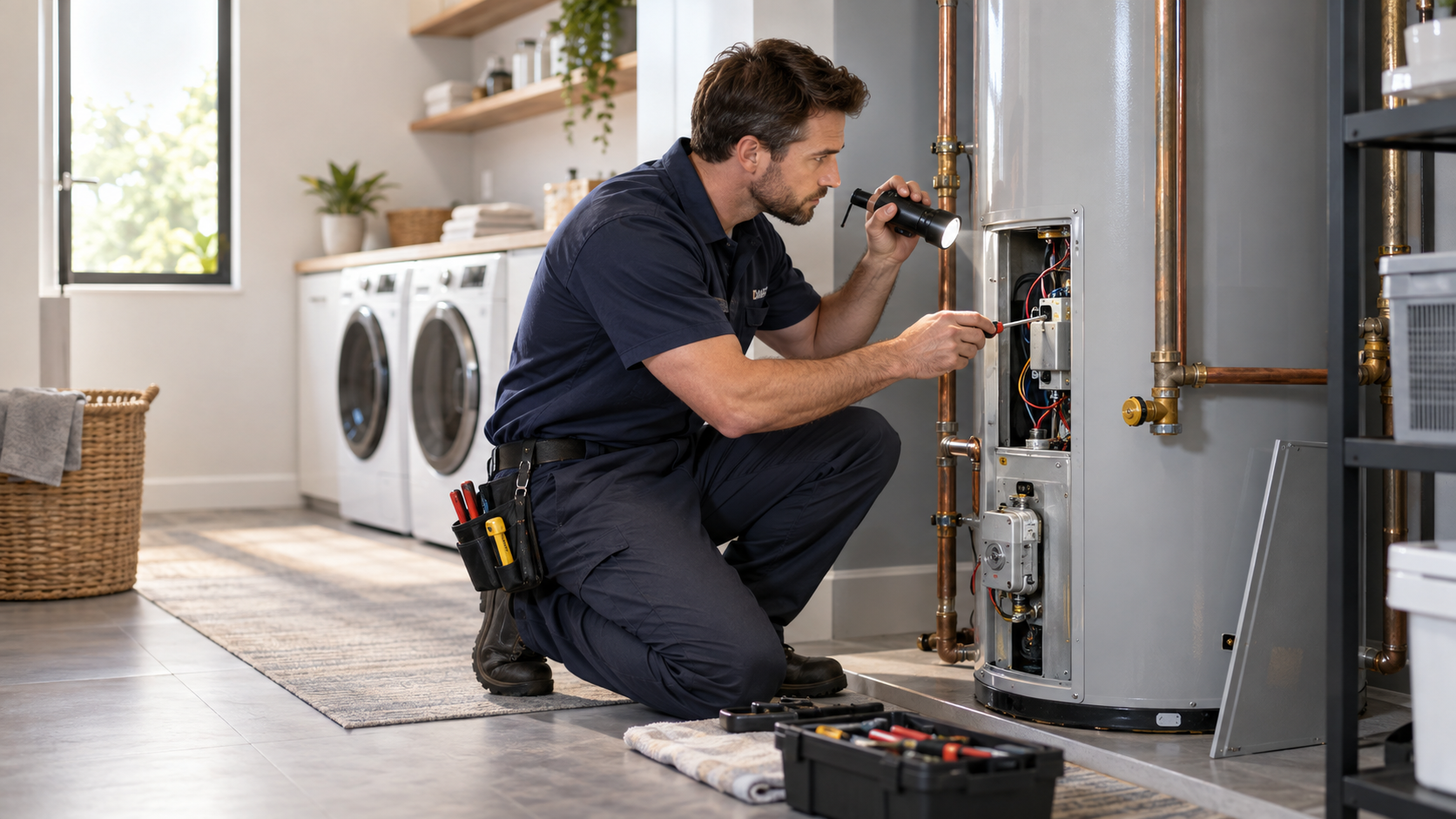
You usually do not think about the water heater when it is working.
You turn on the shower, hot water appears, and that is the end of the story. Then one morning the shower turns cold halfway through. Or you notice a puddle near the tank. Maybe the water smells odd, the heater starts making popping noises, or your utility bill creeps up for no obvious reason.
Suddenly, water heater repair becomes very interesting.
The good news is that not every water heater problem means you need a brand-new unit. Thermostats, heating elements, valves, burners, ignition systems and other components can often be repaired or replaced.
But there is a catch.
A water heater deals with electricity or gas, pressurized water and temperatures hot enough to cause burns. Some repairs are reasonable for an experienced homeowner. Others are firmly in “call a professional” territory.
The trick is knowing which situation you have.
First, what kind of water heater do you have?
Before diagnosing anything, identify the system.
Most U.S. homes use either a traditional storage-tank water heater or a tankless unit. The energy source may be natural gas, propane or electricity. Heat-pump water heaters are also becoming more common.
Different systems fail in different ways.
| Water heater type | How it works | Common repair issues |
|---|---|---|
| Gas tank water heater | Burner heats water stored in a tank | Ignition problems, thermocouple or flame-sensing issues, burner trouble, gas-control problems, leaks |
| Electric tank water heater | Electric heating elements warm stored water | Failed elements, thermostats, wiring problems, leaks |
| Tankless gas water heater | Burner heats water as it flows through the unit | Scale buildup, ignition errors, sensors, venting, flow problems |
| Tankless electric water heater | High-powered electric elements heat water on demand | Heating elements, sensors, electrical connections, flow issues |
| Heat-pump water heater | Moves heat from surrounding air into a storage tank | Fans, filters, sensors, condensate drainage, backup heating elements |
If you do not know what you have, look at the label on the unit. It should list the model, fuel type and electrical information.
Do not guess around a gas connection. That is not the place for improvisation.
The most common signs you need water heater repair
Some failures are obvious. No hot water is hard to miss.
Others are quieter.
A little rust near a connection, a strange sound after the burner starts, or water that no longer gets as hot as it used to can be an early warning.
Common symptoms include:
- no hot water or water that turns cold quickly;
- water that is much hotter or cooler than the thermostat setting;
- leaking around the tank, valves or plumbing connections;
- popping, banging, rumbling or sizzling sounds;
- discolored or rusty-looking hot water;
- unusual odors from hot water;
- pilot or burner problems on gas units;
- repeated error codes on tankless systems;
- reduced hot-water flow;
- water heater shutting off unexpectedly.
A single symptom does not always point to one exact part.
For example, lukewarm water in an electric tank could be caused by a failed heating element, a thermostat issue or unusually high hot-water demand.
Diagnosis comes before parts replacement.
No hot water at all
This is the classic complaint.
With an electric tank water heater, a tripped breaker is one possibility. A failed heating element or thermostat can also stop the system from heating properly.
On a gas unit, the problem might involve ignition, the pilot system on older equipment, the gas control valve or another combustion-related component.
Tankless units can shut down because of ignition faults, inadequate gas supply, blocked venting, low water flow, scale buildup or sensor errors.
If the water heater has a display, note the error code before resetting anything.
That little number can save a technician a lot of detective work.
The water is hot, but not hot enough
This one can be annoying because the heater seems to be working. It just is not doing the full job.
Start with the obvious question: has your household hot-water demand changed?
A traditional tank has a limited supply. Two long showers, laundry and a dishwasher cycle can drain that reserve faster than the heater can recover.
If demand has not changed, then the heater deserves a closer look.
On electric tank units, one failed heating element can leave you with some warm water but not enough hot water.
Heavy sediment can also affect performance in storage tanks.
Tankless systems can struggle when several fixtures demand hot water at once or when incoming winter water is especially cold.
What temperature should a water heater be set to?
Many U.S. households use a setting around 120°F.
That temperature is often recommended as a practical balance between comfort, energy use and reduced scald risk.
Some homes need a different setup because of appliances, household needs or plumbing design, but increasing temperature is not something to do casually.
Hotter water can burn skin quickly.
If your water heater is set near 120°F but the tap temperature is wildly different, there may be a thermostat, mixing or control issue.
Why is my water heater leaking?
A leaking water heater can mean anything from a loose connection to a failed tank.
That difference matters a lot.
Check where the water seems to originate.
A leak at a supply connection may be repairable.
A leaking drain valve might be replaced.
Water around the temperature and pressure relief valve needs investigation rather than simply plugging the valve.
But if the tank itself is leaking through corrosion, repair is generally not realistic.
The tank is the pressure vessel. Once its shell fails, replacement is usually the answer.
And if you see significant water actively escaping, shut off the water supply to the unit if you can do so safely and arrange service quickly.
Do not ignore the temperature and pressure relief valve
The temperature and pressure relief valve, often called the T&P valve, is a safety device.
Its job is to release pressure if dangerous conditions develop inside the tank.
If water is coming from the discharge pipe, do not cap it, plug it or assume the valve is simply annoying.
The valve itself may have failed, but excess pressure or temperature may also be involved.
That needs proper diagnosis.
A dripping safety valve is not a problem you solve with duct tape.
Why does a water heater make popping or rumbling sounds?
Storage water heaters can become noisy when sediment collects near the bottom of the tank.
Minerals in the water can settle out over time. When the burner or heating element warms the area, trapped water can move through the sediment and create popping or rumbling noises.
A little operating noise is normal.
Loud, persistent new noises are worth checking.
Tank flushing may help when sediment is the cause, although heavily neglected or very old units require more caution.
And tankless heaters have their own sounds. Fans, valves and ignition systems can make noises during operation, but grinding, repeated ignition attempts or suddenly louder operation may point to a problem.
Rusty or discolored hot water
If cold water looks clear but hot water appears rusty, the water heater may be part of the problem.
One possible cause is corrosion inside the tank.
Traditional tanks contain an anode rod designed to corrode instead of the steel tank. Think of it as the sacrificial bodyguard of the water heater.
As the rod becomes depleted, protection decreases.
Replacing an anode rod at the right time can help protect a tank, but it cannot reverse a tank that has already rusted through.
If both hot and cold water are discolored, the issue may come from the water supply or piping rather than the heater itself.
Why does hot water smell bad?
Some homeowners describe a sulfur-like or “rotten egg” smell from hot water.
The exact cause can involve water chemistry, bacteria in the tank and reactions involving the anode rod.
It is not a good idea to replace random parts based on smell alone.
The water source matters.
A private well, municipal supply and water-softened system can behave differently.
If the odor is persistent, a plumber or water-treatment professional can help determine whether the heater, water supply or both are involved.
Electric water heater repair: common problems
Electric storage heaters are mechanically simple compared with many gas systems.
They often have two heating elements and one or more thermostatic controls.
A failed element is a very common repair.
If one element stops working, the tank may still produce some hot water, which can make the problem less obvious.
Other electrical issues include loose wiring, bad thermostats, tripped high-limit controls or breaker problems.
But 240-volt electrical work is serious.
Switching off a breaker does not automatically make a person qualified to test live electrical components.
If you are not comfortable verifying electrical isolation with the proper equipment, hire a professional.
Gas water heater repair: where caution matters
A gas water heater adds combustion and exhaust gases to the equation.
That means repairs can involve the burner, ignition system, thermocouple or flame sensor, gas valve, venting and combustion air.
Some older units use standing pilot lights. Many newer systems use electronic ignition.
If you smell gas, do not keep trying to relight the heater.
Leave the area and follow the emergency instructions from your gas utility or local authorities.
If a carbon monoxide alarm activates, treat that as an emergency as well.
Combustion problems are not a good weekend experiment.
Tankless water heater repair is a little different
Tankless water heaters do not store a large tank of hot water. They heat water when a fixture opens.
That saves space and changes how problems show up.
A tankless heater may display an error code instead of simply giving you cold water.
Common issues can involve:
- mineral scale inside the heat exchanger;
- dirty inlet screens or filters;
- ignition or flame-sensing faults;
- venting problems;
- flow sensors;
- gas-supply limitations;
- electronic controls;
- condensate drainage on condensing models.
Hard-water scale is particularly important.
Tankless systems often need periodic descaling according to water conditions and manufacturer guidance.
A unit installed in a hard-water area may need more attention than the same model operating with softer water.
Water heater repair versus replacement
This is the question homeowners actually care about.
Can the heater be fixed, or are you throwing money at a unit that is ready to retire?
Age matters, but it is not the only factor.
Many traditional tank water heaters serve for roughly a decade, though some fail earlier and others last longer. Tankless units can often remain in service longer when maintained properly.
Water quality, installation, maintenance, household usage and manufacturing quality all affect lifespan.
| Situation | Repair may make sense | Replacement may make more sense |
|---|---|---|
| Failed thermostat | Often yes | Usually only if the heater has other major problems |
| Failed electric heating element | Often yes | Consider age and overall condition |
| Ignition component problem | Often repairable | Depends on age, parts and broader system condition |
| Leaking pipe connection | Often repairable | Not usually a reason by itself to replace the heater |
| Tank itself is leaking | Generally no | Usually yes |
| Heavy corrosion | Limited value in repairing | Often sensible |
| Frequent repeated breakdowns | Possibly, if minor | Often worth considering |
| Repair approaches cost of a new unit | Usually less attractive | Replacement may offer better value |
There is no magic rule saying a heater must be replaced the moment it reaches a certain birthday.
A nine-year-old unit needing a small thermostat repair is different from a nine-year-old tank showing corrosion and leaking at the base.
Look at the whole picture.
How much does water heater repair cost?
There is no useful single national price.
Labor costs vary sharply between U.S. cities and regions. The part that failed matters. So does the type of heater, whether emergency service is required and how easy the equipment is to access.
A simple thermostat or heating-element repair is a very different job from replacing a gas control system or diagnosing a complicated tankless heater.
Before approving work, ask for a written estimate.
It should make clear whether the price covers diagnosis, labor, parts and any additional service fees.
If the unit is older and the estimate is substantial, ask what comparable replacement would cost.
Sometimes the repair is an easy yes.
Sometimes the numbers make the decision for you.
Why water heater repair prices vary so much
Two homeowners can describe the same symptom – “no hot water” – and receive completely different bills.
One may need a small electrical part.
The other may have a failing tankless control board.
Access also matters. A water heater sitting openly in a garage is easier to work around than one squeezed into a cramped attic or closet.
Location matters too.
Plumbing labor in Los Angeles, Boston, Miami or New York will not necessarily match labor rates in a smaller Midwestern town.
Emergency scheduling can increase the bill as well.
Can homeowners repair a water heater themselves?
Some maintenance tasks are manageable for homeowners who understand their equipment.
But this is not a great category for learning through trial and error.
Water heaters combine several things that can hurt you quickly: high voltage, natural gas, hot water and pressure.
Tasks that often deserve professional attention include:
- gas-valve or burner work;
- venting or combustion problems;
- electrical diagnosis inside 240-volt equipment;
- major leaks;
- temperature and pressure safety-valve problems;
- tankless error codes that return after basic troubleshooting;
- any suspected carbon monoxide or gas issue;
- replacement involving gas, electrical or plumbing-code changes.
Reading the owner’s manual is always a better first move than watching one random video and assuming every heater is built the same way.
When to shut the water heater off
If the tank is actively leaking, shutting off the water supply can limit damage.
Electrical and gas shutoff procedures depend on the unit.
For electric heaters, power is normally controlled at the breaker.
Gas heaters have gas controls and supply shutoffs.
If you are unsure which valve or breaker controls the heater, do not start flipping and turning things at random.
A plumber can walk you through safe shutdown when arranging emergency service.
A puddle does not always mean the tank has failed
Water near a heater can come from several places.
Supply fittings can drip.
A drain valve can leak.
Condensation can occur in some operating conditions.
A nearby pipe may be the real source.
Heat-pump water heaters also produce condensate as part of normal operation and require drainage.
So find the source before declaring the tank dead.
But if water is clearly coming through the tank body or continuously collecting under a corroded tank, replacement becomes much more likely.
Should you flush a water heater?
Sediment management can be part of normal tank maintenance.
Manufacturers provide specific maintenance guidance, so the owner’s manual should be your reference.
Flushing can help remove accumulated sediment in suitable systems.
There is a nuance, though.
A very old tank that has never been maintained may not behave like a newer unit receiving regular service.
If you have an aging heater with unknown history, heavy corrosion or a questionable drain valve, getting professional advice before aggressively flushing it can be sensible.
Hard water can quietly increase repair needs
Hard water contains higher levels of dissolved minerals, especially calcium and magnesium.
Those minerals can accumulate inside plumbing equipment.
Tank water heaters may develop sediment.
Tankless heat exchangers can develop scale.
Neither happens overnight.
That is why a heater can seem perfectly fine for years and then slowly lose efficiency or develop flow and heating problems.
If your area has hard water, ask the installer or plumber what maintenance interval makes sense for your system rather than waiting for trouble.
Why your hot water runs out faster than it used to
This is a classic “something changed, but nothing broke completely” problem.
On an electric tank, a failed lower heating element can reduce usable hot-water capacity.
Sediment may also reduce effective tank volume or heat transfer.
A thermostat issue is another possibility.
Or the heater may simply be undersized for how your household lives now.
Adding another teenager to a household can test a water heater more effectively than any diagnostic tool.
If hot-water demand changed, repair may not be the answer. Capacity might be.
Do high utility bills mean the water heater is failing?
Not necessarily.
Energy bills can rise because of rate changes, weather, household occupancy or other appliances.
Still, a water heater that runs much longer than normal can contribute.
A failed component, scale buildup, heat loss or hot-water leak may increase energy use.
If the bill changed sharply and the water heater also started behaving differently, the two may be connected.
What about a water heater that keeps tripping the breaker?
Do not repeatedly reset a breaker without finding out why it trips.
A breaker can trip because of a failed heating element, short circuit, damaged wiring or another electrical fault.
The breaker is doing a job.
It is not a button you are supposed to keep pressing until the problem gives up.
If the water-heater circuit trips repeatedly, shut it down and have the electrical problem diagnosed.
How to find a good water heater repair company
A good technician should be able to explain what failed and why the recommended repair makes sense.
Ask whether the company is properly licensed where licensing is required and whether it carries insurance.
For replacement work, ask whether permits and code requirements apply in your area.
Also ask whether the technician regularly works on your specific type of system.
Tankless repair can require different diagnostic skills from basic tank work.
The cheapest service call is not automatically the cheapest outcome.
What information to give the plumber before arrival
A few details can speed things up.
Tell them whether the heater is gas, electric, tankless, tank-type or heat pump.
If possible, provide the model number and approximate age.
Describe the symptom precisely.
“No hot water” is useful.
“The water gets hot for five minutes, then turns cold, and the breaker stays on” is better.
If there is an error code, photograph it.
If there is a leak, take a photo showing where water appears.
This will not replace diagnosis, but it gives the technician a head start.
Preventing the next water heater repair
No maintenance schedule can prevent every failure.
Parts wear out.
Tanks eventually corrode.
Still, routine attention can help equipment perform better and reveal problems earlier.
Follow the manufacturer’s maintenance instructions for flushing, descaling, filter cleaning and inspection.
Keep the area around the heater accessible.
Do not stack boxes against gas equipment or block required air openings.
If the unit has visible corrosion, persistent moisture or unusual noises, deal with the cause before it becomes an emergency.
And know roughly how old the heater is.
That one detail becomes very useful when repair decisions arrive.
Water heater repair in older homes
Older homes can complicate what looks like a simple water-heater job.
The heater may be connected to older piping.
Electrical service may have been modified over the years.
Gas venting may not match current installation requirements.
A replacement unit may also have different dimensions or venting needs.
That is why replacing an old heater is not always a quick “take one out, put one in” project.
A professional may identify code or safety upgrades that were not required when the previous heater was installed.
When water heater repair becomes an emergency
A cold shower is inconvenient.
A gas leak is an emergency.
Those should not be treated the same way.
Urgent situations include a suspected gas leak, carbon monoxide alarm, uncontrolled water leak, electrical burning smell, smoke or signs that the pressure vessel is unsafe.
In those cases, protecting people and property comes before troubleshooting.
For gas or carbon monoxide concerns, leave the affected area and follow emergency guidance from local authorities or your gas utility.
FAQ about water heater repair
How do I know if my water heater needs repair?
Common signs include no hot water, inconsistent temperature, strange noises, leaks, rusty hot water, repeated breaker trips, ignition trouble or tankless error codes. The exact repair depends on the cause, not just the symptom.
Is it worth repairing an old water heater?
Sometimes. A minor repair on an otherwise sound heater may be worthwhile. A leaking tank, severe corrosion or repeated expensive failures usually makes replacement more attractive. Age, condition and repair cost should be considered together.
Can a leaking water heater be repaired?
Leaks from connections, drain valves and some replaceable components may be repairable. A storage tank that is leaking through its own metal shell generally needs replacement because the pressure vessel itself has failed.
Why is my water heater not producing enough hot water?
Possible causes include a failed heating element, thermostat trouble, sediment buildup, equipment that is too small for household demand or a tankless system being asked to supply more flow than it can heat.
How long should a water heater last?
Many storage-tank water heaters operate for roughly a decade, though actual lifespan varies widely. Tankless models can often last longer. Water quality, installation, maintenance and usage all affect service life.
Can I repair a water heater myself?
Basic maintenance may be manageable for an experienced homeowner, but gas systems, high-voltage electrical work, safety valves, active leaks and combustion problems should usually be handled by a qualified professional. Water heaters combine pressure, heat, electricity and sometimes fuel gas.
How much does water heater repair cost in the USA?
There is no reliable single national price. Costs depend on the failed part, heater type, local labor rates, access, emergency scheduling and whether additional work is needed. Request a written estimate and compare major repair costs with replacement when the heater is older.
Conclusion: fix the problem, not just the symptom
Water heater repair is one of those home-maintenance subjects that sounds simple until the heater stops working.
No hot water.
Call a plumber.
Problem solved.
Sometimes it really is that easy.
But the same symptom can come from very different failures.
An electric heater may have one bad heating element.
A gas heater may have an ignition problem.
A tankless unit may be scaled up or displaying a sensor fault.
A storage tank may simply be reaching the end of its life.
That is why good diagnosis matters more than guessing which part sounds familiar from an internet search.
The smartest first question is not, “How do I fix my water heater?”
It is, “What exactly has failed?”
From there, the decision becomes much easier.
If the thermostat is bad, replace the thermostat.
If a heating element has failed, replacing the element can make perfect sense.
If mineral scale is affecting a tankless system, proper service may restore performance.
If a pipe connection leaks, repair the connection.
But if the tank itself has corroded through, there is no clever repair that turns old steel into a new pressure vessel.
That heater is telling you something.
Listen to it.
The same logic applies to age.
Homeowners sometimes treat the age of a water heater like a countdown clock.
Eight years old? Panic.
Twelve years old? Throw it out.
Real life is less tidy.
A well-maintained older heater with a small replaceable part failure may still have useful life.
A much younger tank with serious corrosion or a manufacturing defect may not.
Condition beats birthday.
Repair cost matters too.
Spending a modest amount on a straightforward repair can be sensible.
Spending a large amount on an old tank that has already needed several service calls deserves a harder look.
Ask what a replacement would cost.
Ask how long the repair is expected to last.
Ask whether other major components show wear.
Those are practical questions.
Then there is safety.
This is where water heater repair is different from fixing a loose cabinet hinge or repainting a wall.
Gas burns.
Electricity shocks.
Hot water scalds.
Pressurized tanks need functioning safety devices.
Combustion equipment can produce carbon monoxide when something goes wrong.
There is nothing impressive about taking a risk to save one service call.
A homeowner who knows when to stop is doing DIY correctly.
Maintenance helps too, though it cannot make a water heater immortal.
Storage tanks can accumulate sediment.
Tankless heaters can develop scale.
Filters can become dirty.
Anode rods deteriorate.
Small leaks grow.
Most of this happens quietly.
You do not need to stare at the heater every weekend.
Just pay attention when behavior changes.
Is the water heating more slowly?
Does the hot water run out much sooner than last year?
Has a new sound appeared?
Is there moisture where the floor used to be dry?
Does the tankless display keep showing the same error?
Those small clues are useful.
They also give you the chance to schedule service before a problem turns into a flooded utility room at 2 a.m.
One detail homeowners often overlook is water quality.
The same model installed in two houses can age differently because the water is different.
Hard water can create scale.
Sediment can collect.
Water chemistry can affect anode rods and corrosion.
That is why maintenance recommendations are not identical everywhere in the United States.
A homeowner in a hard-water region may need to think about scale much more often than someone with naturally softer water.
Another overlooked issue is sizing.
Sometimes the heater is not broken.
Your household simply changed.
Two people become four.
A teenager discovers forty-minute showers.
A large soaking tub gets installed.
Suddenly the old water heater “doesn’t work like it used to.”
It may be working exactly as designed.
The demand is just higher.
Before paying for repeated repairs, make sure you are not asking a perfectly functional unit to perform a job it was never sized to handle.
The same issue appears with tankless heaters.
“Endless hot water” does not mean unlimited hot water at unlimited flow.
Every tankless unit has capacity limits.
Run several showers, faucets and appliances together, and the heater still has to raise all that incoming water to the requested temperature.
Winter incoming-water temperature can make that job harder.
That is a performance issue, not necessarily a repair issue.
So when something changes, look at the full situation.
Equipment.
Water quality.
Household demand.
Age.
Maintenance.
Installation.
And the specific symptom.
A good water heater repair technician should do the same.
You should not receive a mystery diagnosis followed by a mystery bill.
The technician should be able to explain the failure in normal language.
They should tell you what part needs attention, why they think it failed and whether anything else looks concerning.
If replacement is recommended, ask why.
“It’s old” may be part of the answer.
It should not always be the whole answer.
If repair is recommended, ask whether the rest of the heater appears sound.
You are not being difficult.
You are trying to understand where your money is going.
And that brings us to cost.
Internet price ranges are useful only up to a point.
A water heater repair in rural Kansas is not priced exactly like one in San Francisco.
A standard heating element is not priced like a tankless control board.
A Tuesday afternoon appointment is not necessarily priced like a midnight emergency.
The quote in front of you matters more than an average floating around online.
Compare like with like.
Does the estimate include diagnosis?
Parts?
Labor?
Permits if needed?
Removal of old equipment if replacement is recommended?
Ask before work starts.
It avoids awkward conversations later.
One more thing: know where your shutoffs are.
You do not need plumbing training to learn which valve supplies water to your heater or which breaker controls an electric unit.
Knowing that before a leak occurs is far easier than learning it while water is spreading across the floor.
If you have a gas system, understand the manufacturer’s normal shutdown instructions as well.
And keep access clear.
A water heater buried behind twelve storage boxes is not helping anyone during an emergency.
In the end, water heater repair is mostly about making a sensible decision at the right time.
Repair the replaceable part when the heater is otherwise healthy.
Replace the unit when the tank or overall system has reached the point where another repair no longer makes financial sense.
Maintain the equipment according to its design.
Do not ignore leaks.
Do not repeatedly reset breakers.
Do not block safety valves.
And do not experiment with gas because a five-minute video made it look easy.
Hot water should be boring.
Turn the faucet, get hot water, move on with your day.
The whole purpose of good water heater repair is to get you back to that boring little luxury as safely and sensibly as possible.
Leave a Reply