
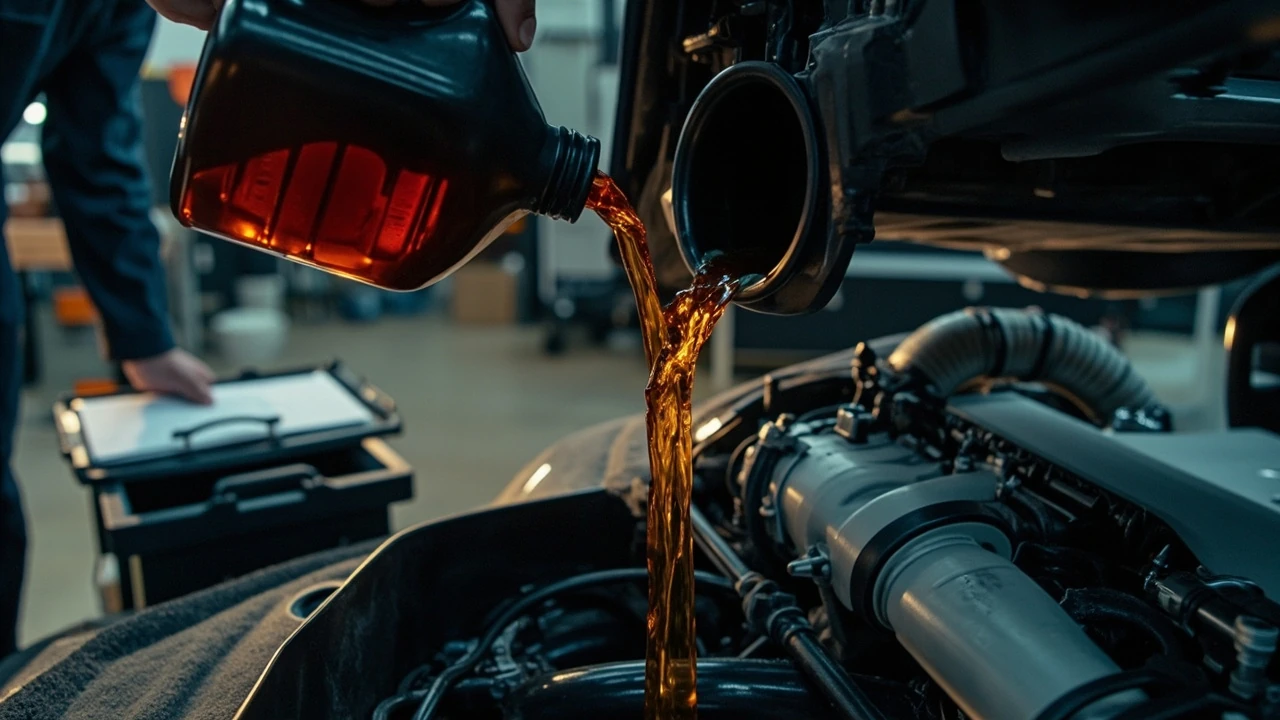
Full synthetic oil change price: what drivers actually pay
A driver pulling into a quick-lube bay in a 2026 Subaru Forester is often quoted somewhere between $85 and $140 for a full synthetic oil change, while a luxury European sedan with a larger sump and a cartridge-style filter can land closer to $200 or more. The exact full synthetic oil change price depends on a small set of variables: the oil volume the engine actually needs, the brand of oil specified in the owner’s manual, the labor rate of the shop, regional taxes and waste-oil fees, and whether the filter is a standard spin-on or a housing that takes a replaceable cartridge. None of these factors is hidden, and each one can be checked before the car leaves the bay.
That mix of transparency and variability is why a useful guide has to do more than quote a single number. The goal of this page is to walk through what actually shapes the bill at independent shops, dealerships, and quick-lube chains, what the same job costs when a driver does it at home, where the real savings are, and where the marketing language around “full synthetic” gets in the way of an honest comparison.
What “full synthetic” actually means in 2026
The phrase full synthetic on a bottle of motor oil is, strictly speaking, a marketing term rather than a regulated grade. The American Petroleum Institute removed explicit references to “synthetic” from its documentation after a long-running dispute in the late 1990s and early 2000s between Mobil and Castrol over whether a heavily modified Group III base stock could be labeled synthetic. After that, the API stopped defining the term, and “full synthetic” became something each oil marketer chooses to apply to a particular formulation.
In practice, most oils sold as full synthetic are built from one of three base stock categories: Group III oils, which are petroleum feedstocks refined so heavily that they behave like true synthetics in nearly every test; Group IV polyalphaolefin oils, which are synthesized from smaller olefin molecules; or blends of the two, often combined with a meaningful dose of additive chemistry. Synthetic motor oils generally offer better low-temperature flow, higher viscosity index, and better resistance to thermal breakdown than conventional oils, which is the reason many modern engines with tight tolerances, turbochargers, or long drain intervals specify them.
The relevant point for a driver shopping for an oil change is not the chemistry argument but the practical consequence: full synthetic oil is usually priced at a premium to conventional oil, and the premium is what shows up on the invoice. The base oil cost is only part of the total, though. A shop that charges $40 for the oil itself may still charge a similar amount for the filter, the labor, shop supplies, and disposal, and that is what brings a typical sedan into the $85 to $140 range.
The five variables that move the bill
Almost every line on a synthetic oil change invoice comes from one of five underlying variables. Understanding them makes it much easier to compare two quotes side by side.
- Oil volume required by the engine. A four-cylinder non-turbo engine may only need 4.5 to 5 quarts, while a turbocharged four-cylinder or a V6 typically needs 5 to 6 quarts. A large V8 or a European luxury engine can require 7 to 9 quarts or more. More oil means more cost at the bottle, and a difference of three quarts can shift the total price by $15 to $30.
- Oil specification and brand. A bottle of 0W-20 full synthetic that meets a basic API SP rating is meaningfully cheaper than a low-viscosity 0W-16 meeting a specific dexos1 Gen 3 license, and both are cheaper than a 5W-40 European formulation that meets a Mercedes, BMW, or Volkswagen long-life approval.
- Filter type and cost. A standard spin-on filter for a common Japanese sedan might be $8 to $12. A cartridge filter with a replaceable housing gasket for a German or Korean car can run $18 to $40, especially if the housing cap is a one-time-use plastic piece.
- Labor rate and shop type. Quick-lube chains typically charge a flat advertised price that already includes the oil, the filter, and the labor. Independent shops and dealerships build the price from parts plus an hourly labor rate that can range from $90 to $200 per hour depending on region.
- Regional and incidental fees. Shop supplies, environmental waste-oil fees, and state-level taxes all add to the total. In a high-cost metropolitan area, two shops using the same oil and filter can still have totals that differ by $25 or more.
Typical full synthetic oil change price by service channel
To make the comparison concrete, the table below uses ranges a U.S. driver in 2026 would commonly see at the three main service channels. They are not promises or a specific regional survey; they are working estimates built from typical national pricing patterns for a non-turbo four-cylinder or V6 sedan using 5 to 6 quarts of oil.
| Service channel | Typical oil and filter cost | Labor and fees | Approximate total range | What the price usually includes |
|---|---|---|---|---|
| Quick-lube chain (e.g., Jiffy Lube, Valvoline Instant Oil Change, Grease Monkey) | $40 to $70 | Built into advertised price | $85 to $140 | Up to 5 quarts of conventional or synthetic blend; full synthetic is usually an upcharge of $20 to $45; standard filter; chassis lubrication on some packages |
| Independent neighborhood shop | $45 to $90 | $25 to $60 labor as part of the service | $90 to $170 | Customer-specified oil and filter; multi-point inspection; occasionally tire pressure and fluid top-offs |
| Franchise dealership | $60 to $120 | $40 to $90 labor | $120 to $220 | OEM oil specification; OEM filter; service record entry; software or maintenance counter reset on some models |
The numbers above assume a routine oil-and-filter service with no add-ons. Add-ons such as engine flush treatments, fuel system cleaners, premium air filter replacements, or transmission fluid top-offs can add $20 to $80 each, and they are typically presented only after the car is already on the lift.
How engine type and oil spec shift the price
Engine size and oil specification are the two specifications a driver can verify without picking up a phone. The owner’s manual lists both. The next table shows how a few common configurations compare, again using 2026 working estimates rather than published retail data from any single chain.
| Engine and oil example | Oil capacity | Filter type | Estimated bottle cost at retail | Estimated full synthetic oil change price at a quick-lube chain |
|---|---|---|---|---|
| 2.5L naturally aspirated four-cylinder (e.g., 2024 Toyota Camry) on 0W-16 | 4.6 qt | Spin-on cartridge | $32 to $45 per 5-quart jug | $90 to $125 |
| 2.0L turbocharged four-cylinder (e.g., 2023 Honda Accord 1.5T) on 0W-20 | 4.4 to 5.0 qt | Spin-on cartridge | $28 to $45 per 5-quart jug | $95 to $135 |
| 3.6L V6 (e.g., 2024 Chevrolet Camaro) on 5W-30 | 6.0 qt | Spin-on cartridge | $30 to $50 per 5-quart jug | $110 to $150 |
| 5.0L V8 (e.g., 2024 Ford F-150) on 5W-30 | 7.0 to 8.0 qt | Spin-on cartridge | $40 to $60 per 5-quart jug | $130 to $180 |
| 3.0L turbocharged inline-six (e.g., 2024 BMW 540i) on 0W-30 LL-04 | 7.0 qt or more | Cartridge-style housing filter | $55 to $90 per 5-quart jug | $180 to $260 |
The European luxury row at the bottom is the one that surprises people the most. The premium is not just for the bottle of oil; it is for the cartridge-style filter housing, the approved oil specification, and the labor to reset the service interval on the dashboard. Drivers who own these vehicles and want a cheaper option can sometimes get comparable results at an independent European specialty shop, where pricing may run $40 to $60 less than the dealer without losing the correct spec.
What a DIY full synthetic oil change actually costs
Doing the job at home is the most direct way to see what is real cost and what is shop overhead. The parts are the same; the labor, fees, and shop supplies are not. For a typical non-turbo four-cylinder sedan, a 2026 DIY estimate looks like the list below.
- Oil: one 5-quart jug of full synthetic at the specified viscosity, $28 to $50, plus a single extra quart if the engine needs it, $7 to $12.
- Filter: a quality aftermarket spin-on or cartridge filter, $8 to $18.
- Drain plug washer or crush gasket: $1 to $3; reusing the original can lead to a slow drip.
- Waste oil containment: a reusable drain pan from a hardware store, $10 to $20, and a free or low-cost drop-off at a local parts store or municipal recycling site.
- Gloves, paper towels, funnel, jack and stands or ramps: $20 to $60 for the ramps if not already owned, with everything else already in a typical garage.
For a single DIY service on a common four-cylinder, the realistic all-in parts cost is $40 to $75. Add the convenience of a $15 to $20 catch pan and the one-time cost of ramps, and the second or third oil change in the same household becomes a clear saving. A V8 or European application can still be done at home but requires more oil, a more expensive filter, and a torque wrench for the drain plug, and the parts bill may run $60 to $120.
What DIY does not give a driver is a paper trail for a leased vehicle, free multi-point inspection, and the convenience of staying in the car. For owners who plan to keep a vehicle long term and can safely work under it on level ground, the math usually favors home service after the second oil change.
How often a synthetic oil change is actually needed
Modern engines with full synthetic oil routinely go 7,500 to 10,000 miles between changes, and some manufacturer maintenance schedules for 0W-16 or 0W-20 applications stretch to 12,000 miles or once a year, whichever comes first. Severe-service schedules, which include frequent short trips, towing, dusty conditions, or extreme temperatures, often cut those intervals roughly in half.
The temptation to over-service is the most common way drivers pay more than they need to for the same job. An owner who changes full synthetic every 3,000 miles on an engine that only needs it every 8,000 is not just spending more on oil changes; they are also producing more waste oil, more filter waste, and more shop visits per year. The owner’s manual and the in-vehicle maintenance reminder are the two most reliable references, and they are usually conservative on the long end. Following them is generally cheaper than following the old “3,000-mile rule,” which was a reasonable rule for mineral oil in the 1970s but not for modern full synthetic.
Where the marketing hides in the bill
Two phrases appear on most synthetic oil change invoices in 2026 that are worth decoding before a driver agrees to the work.
- “Premium full synthetic” or “high-mileage full synthetic.” High-mileage formulations add seal conditioners and slightly more anti-wear additive chemistry to address higher-mileage engines, and they are usually $5 to $12 more per service. They are useful for engines well past 100,000 miles but are not necessary for a 30,000-mile engine, and many chains will include them by default rather than by request.
- “Includes multi-point inspection.” This is a legitimate service that usually takes five to ten minutes, but it is also the moment a shop is most likely to recommend add-ons. A driver who wants to control the bill can decline the recommendations, ask for the inspection sheet, and decide later whether to follow up on any of the items at a different visit.
Both phrases describe real products and real services. The issue is that they are often presented as part of a “package” rather than as a la carte choices, which makes it harder to compare a fair price to a fair price. A quick way to level the comparison is to ask the service writer, in writing or at least clearly, what the base price is for the oil change alone and what each add-on costs.
How to read two oil change quotes fairly
Drivers who call three shops and get three different numbers often get them because the quotes cover different things. The list below is a short comparison protocol that makes the quotes line up.
- Confirm the exact oil specification: viscosity, performance standard (API SP, GF-6, dexos1 Gen 3, MB 229.52, VW 504.00, and so on), and brand if it matters.
- Confirm the filter: aftermarket equivalent, OEM, or “premium” upgrade, and the part number if possible.
- Confirm the oil capacity: ask how many quarts the engine holds so the quote can be matched to the bottle count.
- Confirm the drain plug washer or cartridge housing gasket: is it included, and is it a one-time-use part on cartridge housings?
- Confirm what “labor” covers: just the oil change, or also tire rotation, brake inspection, fluid top-offs, and so on.
- Confirm taxes, shop supplies, and environmental fees: these are real costs but should be on the line, not buried in the labor rate.
Two quotes that match on all six points are genuinely comparable. Two quotes that match on none of them are not, even if the totals look close.
Regional and seasonal patterns worth knowing
Oil change pricing in the U.S. is not uniform, and a few patterns repeat often enough to be useful as rough expectations.
- Coastal metro areas (Boston, New York, San Francisco, Seattle, Los Angeles) typically sit at the high end of quick-lube pricing because of rent, labor costs, and waste-handling fees.
- Midwestern and Southern mid-sized cities tend to be the most competitive, with quick-lube advertised prices occasionally under $80 for full synthetic on a small four-cylinder.
- Mountain and rural regions have fewer quick-lube locations, so independent shops and dealerships carry more of the volume, and pricing can be close to national averages once a long drive is factored in.
- Spring and fall are typically the busiest seasons for oil change chains because drivers schedule service before summer road trips or winter storage, and that demand shows up in slightly higher advertised prices or longer wait times.
None of these patterns is a rule; they are averages. A driver in a high-cost city who finds a small independent shop buying oil in bulk can sometimes pay less than a driver in a low-cost area visiting a national chain.
Common mistakes that raise the bill unnecessarily
Even drivers who know the basics of synthetic oil pay more than they have to when a few predictable mistakes show up. The list below collects the most common.
- Buying a higher viscosity than the engine requires. A 5W-30 bottle on an engine that asks for 0W-20 is thicker when cold and can increase fuel consumption slightly. The owner’s manual viscosity is the right starting point.
- Skipping the crush washer replacement. A worn or missing washer on the drain plug is the most common cause of a small, persistent oil drip under the car, and the part costs pennies.
- Overfilling the engine. Adding a full extra quart on top of the capacity listed in the manual can cause foaming, increase pressure on seals, and in some engines trigger a check-engine light from the oil level sensor.
- Paying for “engine flush” on a healthy engine. A flush can be useful for a neglected engine with heavy sludge, but for a well-maintained engine it just dissolves a small amount of oil and adds cost.
- Following the old 3,000-mile interval. Modern full synthetic and modern engines are designed for longer intervals, and following the manual is usually cheaper and at least as protective.
When the dealer really is the right choice
For most mainstream cars, an independent shop or a quick-lube chain can deliver a service that is identical to a dealership oil change. There are a few situations where the dealer genuinely is the right place to be, and recognizing them avoids the opposite mistake of overgeneralizing.
- Engines under factory warranty with strict service requirements. A few manufacturers publish a “lifetime” engine warranty that is conditional on documented dealer service, and that requirement has to be honored if a future repair is ever contested.
- Engines requiring a specific licensed oil. General Motors dexos1 Gen 3 and certain BMW, Mercedes-Benz, and Volkswagen long-life approvals are spec-locked. An independent shop can absolutely use the right oil; a dealer is the lower-friction path for a driver who does not want to research the spec.
- Vehicles with non-resettable service indicators. Some European and a few Asian models require a scan tool to reset the service interval and to register a new battery if one is replaced. A dealer has that tool as part of the visit; an independent shop may or may not.
Outside of those situations, the deciding factor is usually trust and convenience rather than capability. A driver who already has a relationship with a good independent mechanic, or who is willing to spend an hour on a Saturday morning under the car, can match the result of a dealer visit for significantly less money.
Internal resources for the rest of the job
Oil changes are usually routine, but they are sometimes the moment a homeowner notices an unrelated problem. A slow drain under a workbench, a strange noise in the garage, or a planned remodel around the utility area can turn a basic service appointment into a longer conversation. A few pages from the same site cover problems that often come up in the same season as a synthetic oil service, and the list below links the two that are most often relevant.
How a real bill looks at a quick-lube chain in 2026
To make the abstract numbers tangible, a realistic synthetic oil change invoice for a 2024 Honda CR-V 1.5L turbo at a national quick-lube chain in 2026 might be itemized in roughly the way the table below shows. It is a worked example, not a receipt from any specific shop.
| Line item | Detail | Approximate cost |
|---|---|---|
| Conventional oil and filter package (advertised) | Up to 5 qt of conventional, standard filter, chassis lubrication | $69.99 |
| Full synthetic upgrade | 0W-20 full synthetic meeting API SP and ILSAC GF-6 | $34.00 |
| Cartridge filter upgrade | Manufacturer cartridge instead of standard filter | $12.00 |
| High-mileage additive | Optional, included by default at some chains | $8.00 |
| Disposable shop rags, waste oil handling | $5.00 | |
| Tax (regional) | Sales tax on parts and labor | $9.50 |
| Total | Approximate end-of-visit total | $138.49 |
Two of those line items are genuinely optional. The high-mileage additive on a 25,000-mile engine is a soft sell, and the chassis lubrication is a service that was important for older cars with grease fittings but is largely vestigial on modern sealed components. Dropping those two brings the example to about $120, which is closer to what an informed customer would actually pay.
The five questions to ask before signing the work order
These are the questions a driver can ask in plain language at the counter. They take about 90 seconds and they almost always change the final number.
- What oil viscosity and spec are you using, and can I see the bottle?
- What filter is going on, and is it OEM or aftermarket?
- Is high-mileage additive included by default, and can I opt out?
- Are there any service add-ons you recommend today, and what is each one priced separately?
- What is the all-in total including tax, shop supplies, and any environmental fees?
A good service writer will answer all five without hesitation. Hesitation on any of them is a signal to take the car somewhere else.
Frequently asked questions
What is a normal full synthetic oil change price for a four-cylinder sedan in 2026?
For a typical 2.0L to 2.5L four-cylinder sedan at a national quick-lube chain, a reasonable expectation is somewhere in the $85 to $140 range. An independent shop is usually $90 to $160, and a dealership is $120 to $200. The exact number depends on the oil specification in the owner’s manual, the filter, and regional labor rates.
Is full synthetic worth the extra cost over synthetic blend or conventional?
For engines that call for it in the owner’s manual, full synthetic is worth the premium. It holds viscosity better at high temperatures, flows more easily at cold start, and resists thermal breakdown over long drain intervals. Using a synthetic blend or conventional in an engine that requires full synthetic can shorten the life of internal components, particularly in turbocharged applications.
How much more is full synthetic compared to conventional at a quick-lube?
The typical upcharge for full synthetic over a conventional oil change is $20 to $45 at a national quick-lube chain, depending on the brand and how many quarts the engine takes. The biggest single component of that upcharge is the per-quart cost of the oil itself.
Do I really need to follow the manufacturer’s oil change interval?
Yes. Modern full synthetic oils and modern engine bearings are designed for 7,500 to 12,000 miles between changes under normal conditions, and the in-vehicle maintenance reminder reflects that. Severe-service schedules (very short trips, heavy towing, extreme heat or cold) cut the interval in half, but the basic rule is to follow the manual rather than the older 3,000-mile rule.
Can I switch from full synthetic to conventional to save money?
You can, but it is not recommended for engines designed around synthetic oil. The result is typically shorter drain intervals, slightly higher fuel consumption from increased cold-start friction, and faster additive depletion. The savings per oil change are small relative to the cumulative cost over the life of the vehicle.
Are dealer oil changes more expensive than quick-lube for the same car?
Usually yes, by $20 to $60, and the difference reflects OEM oil, OEM filter, the labor rate, and the service record. The dealer is the safer choice for vehicles with strict warranty service requirements or licensed oil specifications, but for a daily-driver commuter under warranty with a standard spec, a good independent shop will produce the same result at a lower price.
Is a high-mileage full synthetic oil change necessary?
Only for engines with substantially higher mileage, generally above 75,000 to 100,000 miles. High-mileage oils add extra seal conditioners and anti-wear chemistry that can help with slightly hardened valve stem seals. For a newer engine, the added cost ($5 to $12 per visit) does not provide any meaningful benefit.
What is the most expensive part of a synthetic oil change?
At a quick-lube chain it is usually the oil itself, because the labor is built into the advertised price. At a dealership it is usually the labor plus the OEM filter, especially for European vehicles with cartridge-style housings. Either way, the oil volume and the oil specification are the two biggest levers the customer can pull.
Do mobile oil change services charge more?
Mobile services typically price slightly above the local quick-lube chain because they add a travel fee and a convenience premium. For drivers without a place to work on a car at home, the extra $20 to $40 can be worth it. For drivers who already have ramps or a level driveway, a DIY oil change is still the most affordable option.
How can I tell if a shop actually used the oil I paid for?
Ask to see the bottle before it is opened and keep the receipt. Most reputable shops are happy to show both. The oil filler cap, when removed, also reveals a small amount of fresh oil that is the correct color for the brand on the bottle. Discrepancies are uncommon, but the small act of asking is the best prevention.
Leave a Reply