
Concrete leveling contractors: what they actually do and when to call one
A sunken section of driveway can be more than a cosmetic problem. When one corner of a concrete slab drops a half inch or more, the surface starts to channel rainwater toward the garage, creates a trip hazard at the front walk, and slowly pulls the slab away from the garage apron. Plenty of homeowners first try to ignore it, then try a self-leveling compound from a big-box store, and only later call a professional. By that point the slab has usually settled another fraction of an inch, and the gap at the foundation is large enough to notice without a level. This is the situation most concrete leveling contractors are hired to fix: an existing slab that has dropped, cracked slightly, or tilted, where the concrete itself is still in reasonably sound condition and only the support underneath has failed.
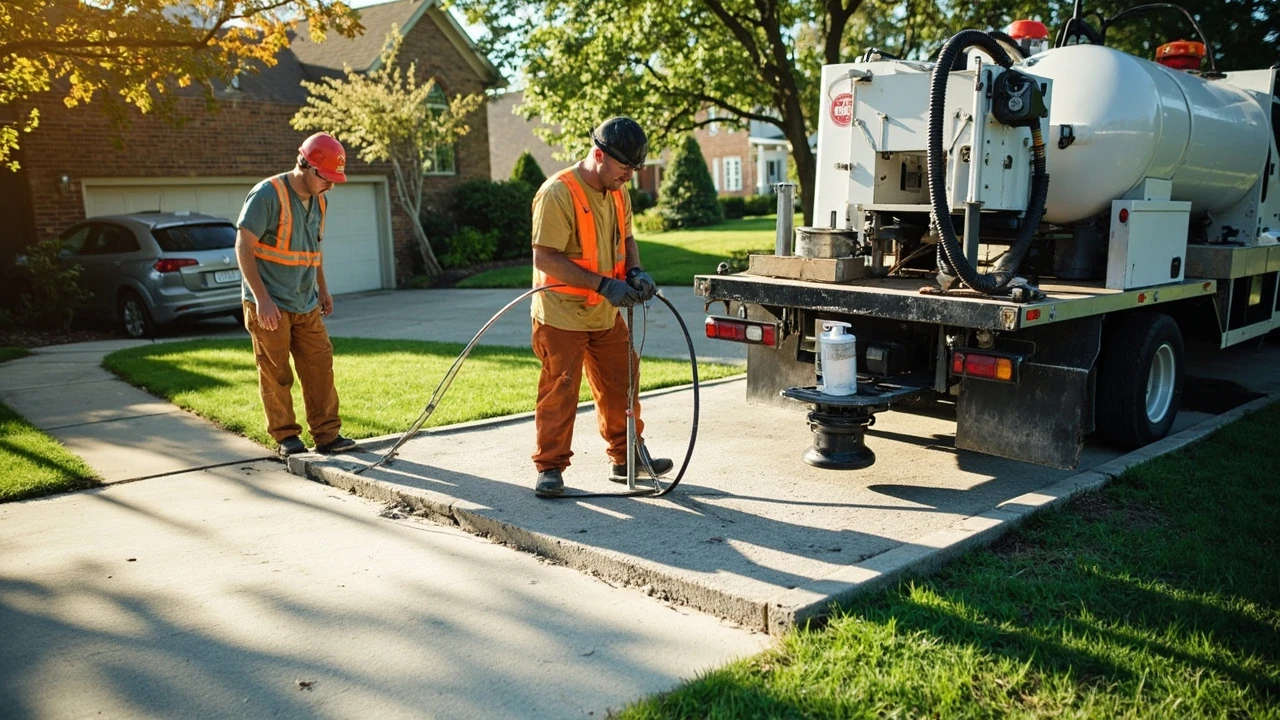
Concrete leveling is a procedure that attempts to correct an uneven concrete surface by altering the foundation on which the surface sits, and it is a cheaper alternative to having replacement concrete poured. The work is commonly performed at small businesses, private homes, factories, warehouses, airports, and on roads, highways, and other infrastructure. A typical residential job takes a few hours. The crew drills a small pattern of holes through the slab, pumps a material underneath that fills the void and pushes the slab upward, then patches the holes with a color-matching grout. The driveway is usually walkable within an hour or two and drivable the same day.
What makes the work interesting, and a little tricky to evaluate as a homeowner, is that three very different methods share the same basic idea. Mudjacking, stone slurry grout leveling, and expanding polyurethane foam leveling all push a slab back into position from below, but they use different materials, different hole sizes, different cure times, and different equipment. Pricing, warranty length, environmental footprint, and how the finished surface looks all vary with the method. A careful choice of concrete leveling contractors therefore depends on understanding the methods, the signs of underlying soil problems, and the questions that separate a careful operator from a quick one.
Why concrete slabs settle in the first place
Before choosing a contractor, it helps to understand what is actually being repaired. Concrete slabs do not sag on their own. The slab is rigid; the ground beneath it moves, and the slab follows. Most settlement comes down to a handful of common causes, and an experienced contractor will look for these on site rather than simply quoting a price per square foot.
The most common cause of slab settlement is an inconsistency of moisture in the soil. Soil expands and contracts as the levels of moisture fluctuate during the dry and rainy seasons, and in some parts of the United States, naturally occurring soils consolidate over time, including areas ranging from Texas up through to Wisconsin. The freeze-thaw cycle in colder states adds another layer of movement. Soil that swells when wet and shrinks when dry slowly develops voids under the slab, and the slab drops into those voids.
Drainage problems make everything worse. Improper drainage allows water to carry soil away from the edges of the slab, which creates voids and undermines the support. Downspouts that discharge right next to a driveway, landscaping that traps water against a patio, or a sidewalk that directs water back toward a basement level all shorten the life of the slab. Concrete slabs built upon filled-in land can excessively settle as well, which is common for homes with basement levels since the backfill on the outside of the foundation frequently is not compacted properly. In some cases, poorly designed sidewalk or patio slabs direct water toward the basement level of a structure.
Tree roots are a third common cause, and they can be powerful enough to lift a slab upward or break through entirely. This is common along public roadways and in older neighborhoods with mature trees. A slab that is suddenly higher in one corner, rather than lower, is often a root problem rather than a settlement problem, and lifting that slab with grout or foam will not solve the underlying cause.
Seismic activity and vibration from heavy traffic can also contribute, especially in earthquake-prone areas. None of this means a sunken slab is a structural emergency, but it does mean a good contractor will ask a few questions about water flow, nearby trees, and the age of the home before quoting the job.
The three methods most concrete leveling contractors offer
The slabjacking process generally starts with drilling access holes in the concrete, strategically located to maximize lift. The hole size, the material pumped through it, and the pressure used depend on the method. The three main process types in residential work are mudjacking, stone slurry grout leveling, and expanding polyurethane foam leveling. Each one has real trade-offs.
Mudjacking
The term mudjacking originates from using a mixture of topsoil and Portland cements injected underground to hydraulically lift concrete slabs. The most common mixture is a local soil or sand blend combined with water and cement, sometimes with additives such as clay or bentonite, fly ash, pond sand, pea gravel, masonry cements, or crushed lime. The mixture gives the material its mud-like consistency, and that is where the name comes from.
This process typically requires holes between one and two inches in diameter. The mud is injected under the concrete slab using a movable pump that can reach most areas, and once the void under the slab is filled, the pressure builds and the slab rises back into position. After the lift, the holes are filled with a color-matching grout.
The main benefits of mudjacking are that it is a low-pressure method, the lift can be controlled in small increments, the equipment can access locations at longer distances than foam trucks can, and the materials are usually accepted at concrete recycling facilities if the slab is ever removed. The trade-offs are that the holes are larger than with foam or stone slurry, more cleanup is required afterward, the warranty period is often shorter than what foam contractors offer, and the material does not resist erosion or fill deep voids as well as polyurethane foam. Mudjacking is also generally slower than foam work because the movable cart moves a smaller material volume.
Stone slurry grout leveling
This method uses a pulverized limestone, commonly called agricultural lime, mixed with water and sometimes Portland cement to create a slurry about the consistency of a thick milkshake. The slurry is pumped hydraulically beneath the slab through roughly one-inch holes. Because of its semi-fluid nature, it pushes against itself and fills voids beneath the slab. Once the void is filled, pressure builds and the slab rises slowly into place.
Trained professionals can control the lift precisely because the working pressure is low, which decreases the likelihood of cracking or damaging the slab further. Once the slurry dries, it creates a near-solid stone foundation for the leveled concrete, much like the original stone base the concrete was poured on. Even without added cement, stone slurry leveling reaches a compressive strength around 240 pounds per square inch, which is equal to 34,560 pounds of lifting force per square foot. With Portland cement added, compressive strength can climb over 6,000 psi, or roughly 864,000 pounds per square foot.
The benefits of stone slurry grout leveling include finely controlled lift, smaller holes than mudjacking, the highest compressive strength of the three common methods, and a budget-friendly price compared to foam. The trade-offs are that the slab to be lifted must typically be within about 100 feet of the truck-based pumping equipment, more cleanup is required than with foam, and without enough cement in the mix, rainwater can eventually erode limestone leveling materials and lead to re-settlement.
Expanding polyurethane foam leveling
Foam leveling uses a two-part polymer injected through a hole less than one inch in diameter. The material is injected at a higher pressure than traditional cementitious grouts, but the pressure is not what actually lifts the slab. The expansion of the air bubbles in the injected material below the slab surface performs the lifting action as the liquid resin reacts and becomes a structural foam. The material first finds weak soils and expands into them, consolidating the sub-soils and filling any voids below the slab, then it begins pushing the slab upward as it expands.
Closed-cell polyurethane foam reaches a hydrophobic state when cured, with full cure times as little as 30 minutes. Closed-cell injections do not retain moisture and are not subject to erosion once in place. Some closed-cell polymer foams have baseline lifting capabilities of 6,000 pounds per square foot, and leveling procedures have been performed in which loads as high as 125 tons have been lifted and stabilized in a surface area of less than 900 square feet. Some foams are stronger still, with compressive strengths of 50 psi and 100 psi in a free-rise state, equal to 7,200 to 14,000 pounds per square foot of support.
The benefits of foam leveling include the smallest hole size of the three methods, fast cure time, water resistance, and a long warranty from most contractors. The trade-offs are higher material cost, the equipment is truck-based and needs reasonable access, and the cured foam is not accepted at all concrete recycling facilities. Foam also does not work well on every slab, especially very thin or badly cracked ones, because the injection pressure can crack brittle concrete.
What concrete leveling contractors actually do on site
The visible part of the work happens fast, which is one reason a careful homeowner should pay attention to what happens before the drilling starts. A standard residential job follows a predictable sequence, and most of the value is in steps the homeowner never sees.
- Site walk and assessment. The contractor walks the affected area, checks the slab for cracks and hollow spots, looks at drainage, and asks about irrigation lines, downspouts, or sewer laterals that might run under the slab. This is also when the crew identifies trip hazards and confirms that the slab is a candidate for leveling rather than replacement.
- Pattern of injection holes. The crew marks where holes will be drilled, usually in a grid or staggered pattern, with extra holes near the lowest corner of the slab. The pattern matters because it controls how evenly the slab rises.
- Drilling. A hammer drill or core drill cuts through the concrete. Hole size depends on the method: roughly 1 to 2 inches for mudjacking, about 1 inch for stone slurry, and less than 1 inch for foam.
- Injection. The crew connects the pump hose to the first hole and begins injecting material. They watch the slab, listen for the sound of the material moving, and stop when the slab reaches the desired height. They then move to the next hole.
- Finishing. The holes are patched with a color-matching grout or concrete, the surface is cleaned, and the crew checks for any new cracks that appeared during lifting.
- Walk-through and warranty paperwork. The contractor reviews the work with the homeowner, points out anything that was already cracked before the lift, and hands over the warranty terms in writing.
Most residential jobs take two to four hours of on-site time. Larger jobs, or jobs that involve lifting load-bearing slabs such as garage floors, take longer. Driveways and walkways are usually usable within hours, while heavy vehicles should stay off foam-lifted slabs for at least 24 hours and off mudjacked or stone slurry slabs for 24 to 48 hours.
How to evaluate concrete leveling contractors
The difference between a careful contractor and a careless one usually shows up before the first hole is drilled, not after. A few practical checks help separate the two.
- Ask which method they recommend and why. A contractor who offers all three methods will recommend one based on the slab, the soil, the access, and the budget. A contractor who only does foam may push foam even when stone slurry or mudjacking is the better fit, and vice versa.
- Ask about the injection pattern. Crews that drill a thoughtful pattern of holes are controlling the lift. Crews that drill only at the lowest spot are pushing one corner up and hoping the rest follows, which often produces a new high spot and new cracks.
- Request a written scope. The quote should list square footage, method, hole count if available, material type, patch material, and what is excluded. Tree root removal, drainage correction, and crack sealing are usually separate line items.
- Ask about warranty and what voids it. Most contractors offer a one- to five-year warranty on residential work. Foam contractors often advertise longer warranties. The fine print usually excludes settlement caused by poor drainage, plumbing leaks under the slab, or new construction adjacent to the slab.
- Verify insurance and references. General liability and workers’ comp are non-negotiable. Ask for two or three references from jobs done at least two years ago, so the homeowner can see how the lift held up.
- Watch the cleanup. Mudjacking and stone slurry leave more mess than foam. A careful crew will protect landscaping, rinse the area, and leave the slab broom-clean. The way a crew treats the work site before they start is usually a good predictor of how the actual lift will go.
Comparing the three methods side by side
The table below compares the three main methods on attributes that actually matter to a homeowner. Pricing varies by region, so absolute dollar figures are not used; instead, the methods are compared in relative terms based on how concrete leveling contractors typically describe their services.
| Attribute | Mudjacking | Stone slurry grout leveling | Polyurethane foam leveling |
|---|---|---|---|
| Hole size | 1 to 2 inches | About 1 inch | Less than 1 inch |
| Typical residential cost | Lowest | Low to mid | Highest |
| Cure time before use | 24 to 48 hours | 24 to 48 hours | About 1 hour; full cure in 24 hours |
| Compressive strength | Moderate | High (up to 6,000 psi with cement) | High (50 to 100 psi in free rise; hydrophobic) |
| Erosion resistance | Lower | Lower without added cement | High (closed-cell, hydrophobic) |
| Cleanup required | Highest | Moderate to high | Lowest |
| Typical warranty | Shorter (1 to 3 years) | Mid-range (2 to 5 years) | Longer (3 to 10 years) |
| Equipment reach | Long, cart-based | About 100 ft from truck | Truck-based, shorter reach |
| Recyclability of slab later | Accepted at most recycling facilities | Accepted at most recycling facilities | May require separation from foam |
Method choice is rarely about which one is “best.” A long driveway with a single low spot near the street is a good candidate for mudjacking because the cart can reach. A pool deck with thin, decorative concrete is a better candidate for stone slurry because the pressure is low. A garage floor or warehouse slab that needs to bear weight quickly is a natural fit for foam because the cure time is short and the load capacity is high.
When leveling is the wrong repair
Leveling is not a universal fix. There are real cases where replacement is the only correct answer, and a good contractor will say so.
- The slab is too badly cracked. Slabjacking requires the concrete to be in fairly sound condition. If there are too many cracks, replacement might be the only option, because the slab no longer behaves as a single rigid piece.
- New cracks form during the lift. New cracks can occur as the slab is lifted. Most of these were already present and not visible before lifting, but a slab that breaks into multiple pieces during the lift was never a good candidate in the first place.
- Re-settlement is likely. Possible resettlement occurs when concrete was poured on top of poorly compacted soils and the underlying cause has not been addressed. However, this is also possible with new concrete poured over the same poor soils, so the question is usually one of degree, not kind.
- The cause is a root, not a void. If a slab is being pushed up by a tree root, leveling will not remove the root and the slab will lift again. Removing the tree or the offending root is the actual repair; the slab can then be lowered back into place.
- The slab is too thin. Foam injection in particular needs enough concrete thickness to lift without punching through. Very thin slabs, such as some old patios, are better replaced than lifted.
A contractor who inspects a slab and recommends replacement rather than leveling is usually a more trustworthy contractor than one who cheerfully promises to lift any slab. Replacement costs more, takes longer, and disrupts the site, but it is the correct answer for a slab that leveling cannot save.
How contractors estimate the cost of a leveling job
Most concrete leveling contractors price residential work in one of two ways: per square foot of slab, or per hole with a minimum service charge. Both approaches can produce fair prices, and both can be abused, so it helps to understand what the estimate should include.
| Cost factor | What drives it | How it affects the estimate |
|---|---|---|
| Slab size and thickness | Larger and thicker slabs need more material and more lift force. | Increases total cost, often in a stepwise way. |
| Amount of settlement | A slab that has dropped two inches needs more fill than one that has dropped a quarter inch. | More material, more pumping time. |
| Accessibility | Truck-based methods need room to park; mudjacking carts can go further. | Foam and stone slurry jobs in tight backyards may carry a surcharge or may be impractical. |
| Method chosen | Foam is generally the most expensive per square foot; mudjacking is generally the least. | Method choice can swing the estimate by 30 to 50 percent. |
| Number of holes | More holes mean more patching and more labor. | Mudjacking requires larger and often more holes than foam. |
| Prep and protection | Moving planters, lifting pavers, protecting landscaping. | Some contractors include this, others charge extra. |
| Crack sealing and patching | Cosmetic repairs after the lift. | Often a separate line item. |
| Drainage or root correction | Fixing the underlying cause of settlement. | Usually a separate scope of work and a separate contractor. |
A reasonable estimate will list the method, the area to be lifted, the number of holes if known, what is included, and what is excluded. Estimates that only show a single number with no breakdown are harder to compare. Estimates that bundle the leveling with a separate concrete pour, drainage correction, or root removal are worth a second look, because the buyer may end up paying for work that another trade could do more cheaply.
Questions to ask concrete leveling contractors before signing
Homeowners who know what to ask get better work. The questions below are deliberately practical, and a careful contractor will answer each one without hesitation.
- Which lifting method do you recommend for this slab, and why?
- What hole size will you drill, and how many holes do you expect?
- What compressive strength does the material reach, and how long does it take to cure?
- Is the material hydrophobic, and will it resist erosion if the underlying soil stays wet?
- What is the warranty period, and what specifically voids it?
- Do you carry general liability and workers’ comp insurance, and can you send a certificate?
- Will the slab be walkable or drivable the same day, and when can heavy vehicles return?
- What is included in the price, and what would be billed as extras?
- Can you provide two or three references from jobs done at least two years ago?
- Do you subcontract the work or use your own crew?
The order of these questions is not random. Method and warranty define the work; insurance and references protect the homeowner; the practical questions about cure time and pricing reveal how much thought the contractor has already given the job.
How the lift interacts with surrounding slabs and structures
Leveling one slab in a connected system of concrete can affect its neighbors. Garage floors meet driveways meet aprons meet sidewalks meet patios, and they are often poured as separate slabs with expansion joints between them. When one slab is lifted, the joint with the next slab changes.
A careful contractor will check the joints before lifting and warn the homeowner if the lift is likely to open a gap at a joint. In some cases the crew will lift multiple slabs together as a single unit, which requires coordination across more holes but produces a more even result. In other cases the homeowner is better served by lifting only the worst slab and leaving the others alone, accepting that the joint will be slightly different.
The same logic applies to where a slab meets a foundation wall. Lifting a slab that has dropped away from the foundation is the desired result, but lifting a slab that is still bonded to the foundation can crack the foundation or the slab at the bond line. Foundation attachment is one of the things a contractor should look at during the site walk.
What the homeowner can do to make the lift last
Leveling fixes the symptom. The cause of the settlement is almost always soil and water, so the lift will last longer if the soil and water situation is addressed. None of this is complicated, and most of it is free.
- Redirect downspouts. Downspouts that discharge within five feet of a slab should be extended further out, ideally to a daylight drain or a dry well.
- Regrade soil along the slab edge. Soil that slopes toward the slab will carry water under it. A slope of about one inch per foot away from the slab for the first six to ten feet is the usual target.
- Stop irrigation overspray. Sprinklers that hit a slab every day keep the soil on one side wet and the other side dry, which is a recipe for differential settlement.
- Manage trees. A mature tree can lift a slab as easily as it can drop one. The choice of planting location near future slabs is worth thinking about before pouring new concrete, but existing slabs can be protected with root barriers.
- Seal cracks.
- Watch for plumbing leaks.
A polyurethane or silicone crack sealer keeps water from washing fines out of the base under the slab, which is one of the slower ways slabs settle.
A leaking sewer lateral or water service line under a slab can wash out the base in months, which no amount of leveling will fix permanently.
Concrete leveling contractors do not usually do this kind of work themselves, but the best ones will mention it during the site walk and may recommend a landscaper, a drainage contractor, or a plumber if the situation calls for it.
How the job fits into a broader home maintenance plan
For readers who already deal with other home service decisions, leveling a slab is one piece of a larger pattern. The same homeowner who notices a sunken driveway section may also be thinking about whether to call a plumber about a slow drain, whether to schedule a brake job on the family car, or whether to upgrade the attic insulation. None of these jobs require the same trade, but the underlying decision is similar: which contractor to call, what method to choose, what to expect to pay, and how to avoid getting upsold on work that is not needed. The same editorial approach, walking through the actual decision rather than the marketing pitch, applies across all of them. A homeowner who has already learned how to evaluate one trade has a head start on the next.
For homeowners who want a related read on home repair decisions more broadly, a useful starting point is Plumbing Repair: What Homeowners Need to Know Before a Small Problem Gets Expensive, which follows a similar approach to evaluating service contractors and avoiding the most common pitfalls.
Frequently asked questions
How long does concrete leveling take on a typical driveway?
Most residential driveways take two to four hours of on-site time. The slab is usually walkable within an hour or two for foam and within 24 to 48 hours for mudjacking or stone slurry. Heavy vehicles should stay off any newly lifted slab for at least 24 hours and sometimes longer, depending on the method and the slab thickness.
Is concrete leveling cheaper than replacing the slab?
Leveling is generally a fraction of the cost of replacement. Replacement involves demolishing the existing slab, hauling the concrete away, re-prepping the base, pouring new concrete, and waiting for it to cure, which can take a week before the surface is usable. Leveling avoids most of those steps and is typically usable the same day.
Can any sunken slab be lifted, or are some slabs too far gone?
Slabs that are heavily cracked, broken into pieces, or that have settled more than a few inches are usually not good candidates. Slabs with severe underlying drainage or plumbing problems will continue to settle even after leveling, so the underlying problem has to be addressed first. A reliable contractor will tell the homeowner when replacement is the right answer rather than trying to lift a slab that will not hold up.
How do I know whether mudjacking, stone slurry, or foam is right for my slab?
The choice depends on the slab thickness, the amount of settlement, the access, the desired cure time, and the budget. Thin, decorative slabs usually do better with low-pressure stone slurry. Long driveways with deep voids are often well-served by mudjacking because the equipment can reach. Garage floors and slabs that need to bear heavy loads quickly are usually a good fit for foam. A contractor who offers all three methods will recommend one based on the actual conditions rather than a one-size-fits-all approach.
How long will a lifted slab stay level?
A properly lifted slab with a working drainage system and a stable base typically stays level for many years. The most common cause of re-settlement is the underlying soil problem returning, often because of a new plumbing leak, a new downspout location, or continued irrigation overspray. Most contractors back their work with a one- to ten-year warranty, and foam contractors tend to offer the longest terms.
Will the holes drilled in the slab be visible after the work is done?
Smaller holes are easier to hide. Foam holes are less than one inch across, stone slurry holes are about one inch, and mudjacking holes are one to two inches. After the lift, the holes are patched with a color-matching grout or concrete, and the patches are usually visible on close inspection but blend in from a normal viewing distance.
Can leveling fix a slab that is sloping toward the house?
Leveling can correct the slope of a slab, but only within the limits of how the slab is supported. If a slab is sloping toward the house because the soil on the house side has settled, lifting the low side can correct the slope. If the slab is sloping because the soil on the house side is being pushed up by a root or a frost lens, lifting the low side will not fix the cause. The site walk is where this question gets answered for a specific slab.
Do concrete leveling contractors need a permit?
Most residential concrete leveling does not require a building permit because it is considered a repair rather than new construction. Some municipalities require a permit for larger commercial jobs, and any work that involves plumbing or drainage correction may trigger a separate permit. A contractor working in the homeowner’s municipality will know the local rules.
What should I do to prepare the site before the crew arrives?
Move vehicles off the slab to be lifted. Clear the area of planters, patio furniture, and doormats. Mark any sprinkler heads, landscape lighting, or invisible fence lines that run under the slab, so the crew knows what is underneath. If the home has a known sewer cleanout or water shutoff under the slab, point that out during the site walk.
Will lifting one slab damage neighboring slabs or the foundation?
In most cases no, because each slab is independent and is separated from its neighbors by an expansion joint. The crew controls the lift at each hole and stops when the slab reaches the desired height, which limits the force transmitted to neighboring slabs. The exception is when one slab is bonded to another, such as a porch that was poured against a foundation wall. The site walk identifies these situations in advance, and the contractor will adjust the plan accordingly.
A practical next step
The single most useful thing a homeowner can do before calling concrete leveling contractors is to take three measurements of the affected slab and write them down: the distance from the lowest point to a true horizontal reference, the length of the largest crack if any, and the approximate size of any void that can be felt by walking across the slab. Those three numbers tell a contractor a great deal about the job, and they let the homeowner compare estimates on the same basis. A written estimate that lists the method, the area, the number of holes, the warranty, and the exclusions is the next step. Two or three such estimates, from contractors willing to walk the site in person, are usually enough to make a confident choice without overpaying for a method that the slab does not need.
Leave a Reply