Bird removal: what it actually means for a homeowner
A neighbor hears scratching in the bathroom exhaust fan every morning at sunrise. A homeowner notices the dryer runs hot but the clothes stay damp. A restaurant manager finds a loading-dock ledge slick with droppings again, two days after the power wash. Each of those situations is what the trade calls a bird problem, and each one ends with a decision about bird removal that is more specific than the phrase suggests.
Bird removal is the process of identifying a nuisance bird species, locating where it is roosting or nesting, removing the bird and nesting material where the law allows, and then excluding the structure so the same problem does not return next season. Done correctly, it is part inspection, part carpentry, and part wildlife law. Done carelessly, it can mean a federal fine, a fire in the dryer duct, or a mite infestation that lingers in the living room long after the nest is gone.
This guide explains how bird removal works for typical U.S. homes, which species you are most likely to deal with, which ones the federal government protects, what a thorough job looks like, and what it should cost. It also covers the situations where a homeowner can reasonably handle the work and the cases where calling a licensed wildlife control professional is the safer choice.
Why bird removal is not just a nuisance problem
Birds in the wrong place are a maintenance issue with a surprisingly long list of downstream effects. The visible part is noise and droppings. The hidden part is where the real damage happens.
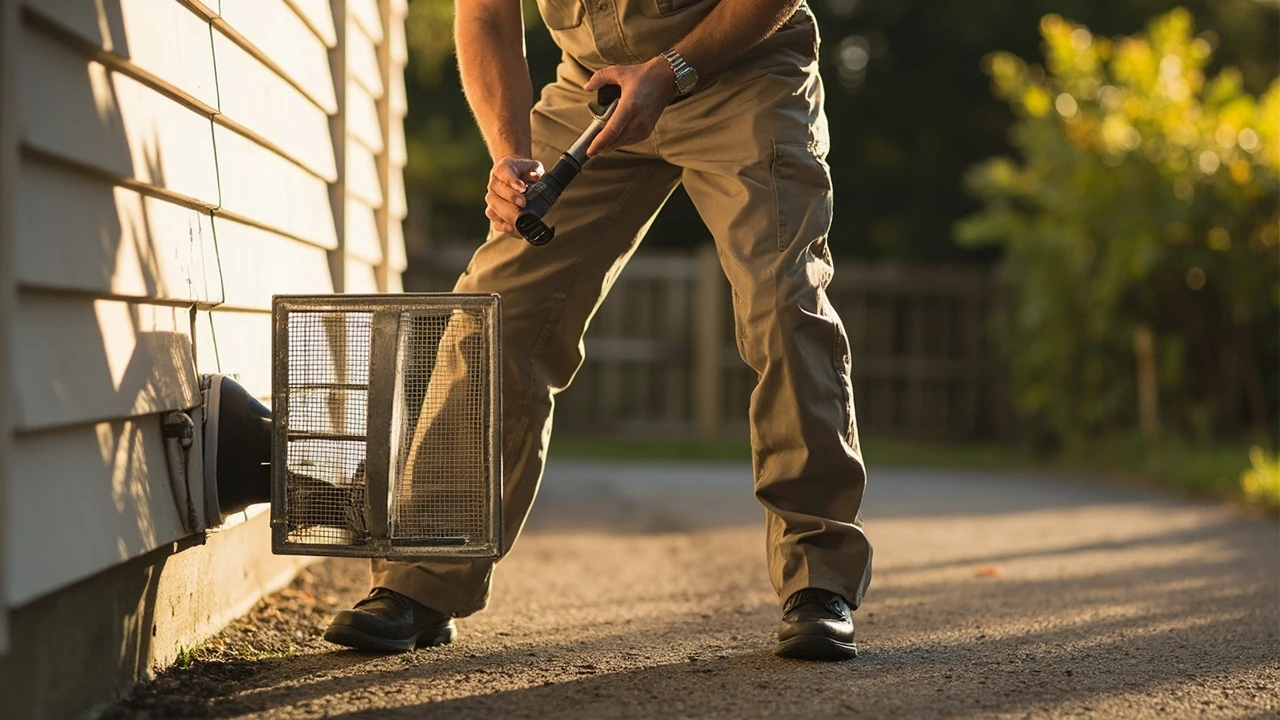
Vents are the highest-risk entry point. Dryer vents, bathroom exhaust fans, range hood vents, and even AC condensate lines are all openings about the right size for a starling or sparrow to push into. Once inside, the bird packs the duct with sticks, grass, feathers, and lint. Airflow drops. The dryer runs longer and hotter. The U.S. Fire Administration has long tracked clogged dryer vents as a recurring cause of house fires, and a bird nest packed on top of built-up lint is one of the worst combinations possible. A bathroom or kitchen exhaust blocked in the same way can pull exhaust fumes back into the living space, which is a different but related indoor-air problem.
Chimneys are the second common entry. Chimney swifts are small birds that roost vertically inside masonry flues and are federally protected, so removal timing matters. Other species sometimes end up in chimneys by accident and cannot find their way out, leaving the homeowner with noise, smell, and a bird that may not survive.
Attics, soffits, and roof lines are the third category. A gap behind a fascia board or under a loose soffit panel is enough for a house sparrow pair to set up a season-long nest. Once chicks fledge, the nest stays. Mites move in. Insulation gets soiled. The repair bill climbs well past the original bird issue.
Then there are the health factors. Bird droppings can carry histoplasmosis and cryptococcosis, both of which become a real concern with large accumulations, particularly in commercial or barn settings. Bird mites are a more common residential complaint: they live in the nest, feed on the birds, and when the birds leave, the mites migrate into the living space looking for a new host. The bites look like small red welts, often on the arms and torso, and they keep appearing for days after the nest is gone, which is how homeowners first realize the problem was birds in the first place.
None of this means a single robin on the lawn is cause for alarm. The category of bird removal only applies once a bird has chosen the structure as habitat, not when one is simply passing through.
Which birds cause problems and which ones you cannot touch
Almost every native bird species in the United States is protected under the Migratory Bird Treaty Act. That law makes it illegal to remove, relocate, or destroy an active nest of a protected species, and the fines are not symbolic. A homeowner who knocks down a nest with eggs in it, even on their own property, can face a federal enforcement action. This is the single most important piece of background a homeowner needs before doing anything to a nest.
There are three common species that are not protected and that cause the majority of residential complaints. A professional bird removal service starts by figuring out which one is on the property, because the answer drives the legal options.
| Species | Typical nesting sites | Legal status (U.S.) | Main risks |
|---|---|---|---|
| European starling | Dryer vents, bathroom exhaust fans, range hood vents, soffits | Not protected; can be removed any time | Blocked vents, fire hazard, aggressive toward native birds |
| House sparrow | Gaps in soffits, behind shutters, vents, building facades | Not protected; can be removed any time | Bird mites, noise, droppings on siding and walkways |
| Rock pigeon | Ledges, overhangs, parking structures, flat roofs | Not protected; can be removed any time | Acidic droppings damage paint, metal, and masonry |
The protected species that show up in homes are usually chimney swifts, house finches, and woodpeckers. None of these can have an active nest disturbed, even on private property.
| Protected species | Where it shows up | What you can do | When to act |
|---|---|---|---|
| Chimney swift | Inside masonry chimneys | Install a chimney cap after the birds leave | After nesting season ends, typically September or October |
| House finch | Vents, exterior light fixtures, decorative features | Wait for fledging, then exclude | After young leave the nest, usually within a few weeks |
| Woodpecker | Wood siding, fascia, trim | Repair damage, install deterrents | Outside breeding season, or under specific permits |
The pattern is simple: a homeowner has full authority to act on starlings, sparrows, and pigeons, and a federal restriction on timing for most other species. A good inspection sorts this out before any work begins.
How a professional bird removal job is actually done
The word “removal” is misleading on its own. A serious bird removal service treats the problem as three connected steps: inspect, remove, exclude. Skipping any one of them means the same birds, or their replacements, come back next season.
Step 1: Inspection and species identification
A technician walks the exterior, looks at every vent cover, soffit line, chimney crown, and roof edge, and asks the homeowner where the noise or droppings are worst. The goal is to identify the species, the entry point, and how many openings need to be addressed. The species identification matters because it dictates what is legal to do and when.
A good inspection also looks at the cause, not just the symptom. A vent that has been packed with sticks for two years did not start there; the original vent cover was missing or the flap stopped closing. The exclusion step will not work if the underlying gap is not fixed.
Step 2: Removal of birds and nesting material
For unprotected species, the technician removes the bird, any chicks that are old enough, and the nest material itself. Nest material is the part homeowners tend to forget. Leaving the nest in place attracts mites and signals to other birds that the spot has been used successfully.
For protected species with active nests, this step is delayed until the young have fledged. The technician usually comes back later in the season. A homeowner should be skeptical of any service that is willing to “take care of it tomorrow” on a protected species during nesting season, because that is exactly the kind of work that leads to fines.
Step 3: Exclusion work
Exclusion is the part that determines whether the job lasts. It usually involves one or more of the following, depending on the structure:
- A bird-proof vent cover on the dryer, bath, or range vent. The cover has a loupered or spring-loaded flap that lets air pass but blocks entry.
- A stainless steel chimney cap sized to the flue, which keeps out swifts, squirrels, and raccoons while allowing smoke to vent.
- Mesh or hardware cloth screwed over gaps in soffits, behind shutters, or under fascia boards.
- Bird netting stretched across larger openings on commercial facades, parking decks, or warehouse eaves.
- Spike strips or tension wire on ledges where pigeons roost.
Exclusion is also the part of the job where a homeowner sees the most variation in price, because the labor and materials depend entirely on the structure. A single dryer vent cover is a small job. A netted parking structure is a multi-day project with lifts and a crew.
Where birds actually cause damage on a house
The same four locations show up on most service calls. The list below is in roughly the order of how often each one appears in a residential job, based on what typical U.S. wildlife control companies report.
- Dryer vents. The most common site. A starling pair can pack a 4-inch duct with nesting material in a single week. The homeowner usually notices the symptom first: longer dry times, a hot dryer cabinet, a burning smell, or a vent flap that never opens because it is wedged shut with sticks.
- Bathroom and kitchen exhaust vents. Same biology, smaller consequences. The vent stops working, the bathroom mirror stays fogged, the kitchen range hood recirculates smoke, and the homeowner is often the last person to connect the symptoms to a bird.
- Chimneys. Swifts in occupied chimneys create a noise problem and a draft problem. After nesting season, a cap solves it for good. A single cap install is one of the more cost-effective pieces of exclusion work available.
- Soffits, fascia, and roof lines. Sparrows favor these. The damage is usually cosmetic first, then structural, as droppings accumulate and moisture gets into places it should not.
Each of these situations calls for a slightly different approach, and the same service company that handles a vent job is not always the right call for a chimney or a netted facade. It is reasonable to ask what kind of work a company does most before booking.
What bird removal should cost in practice
Pricing varies by region, by structure, and by species, but the categories below hold up across most of the country. The numbers are meant as a sanity check, not a quote; the right way to price a specific job is to get two or three written estimates from local licensed operators.
| Service | Typical scope | What drives the price | Realistic range per visit (U.S.) |
|---|---|---|---|
| Dryer vent extraction and cover | Remove nest, clear duct, install bird-proof cover | Duct length, roof height, whether the cover is special-order | $150 to $400 |
| Chimney cap install (post-season) | One flue, standard cap, single-story access | Chimney height, cap material, cap size | $200 to $500 |
| Soffit or vent exclusion | Patch gaps, install mesh, replace damaged cover | $250 to $900 | |
| Attic nest removal and cleanup | Remove nest, treat for mites, sanitize, deodorize | Size of contaminated area, insulation replacement, mite treatment | $400 to $1,500 |
| Commercial pigeon netting or spikes | Ledge protection, netting on facade, deterrent wire | Square footage, lift rental, number of access points | $1,500 to $10,000+ |
A few rules of thumb help when reviewing an estimate. First, a low bid that does not include exclusion work almost always means the birds will return. Second, a bid that does not name the species or describe how the protected-species timing will be handled is incomplete. Third, mite treatment should be a separate line item when an attic or vent nest has been in place for a long time, since mites will keep biting the homeowner for days after the nest is gone.
Bird removal and the law: what a homeowner needs to know
The Migratory Bird Treaty Act covers most native species and is enforced at the federal level. State rules add their own layers in some places. A homeowner does not need to become a wildlife lawyer, but a working knowledge of the framework prevents expensive mistakes.
- Active nests of protected species cannot be disturbed, even on your own roof. “Active” means eggs or chicks are present, or the nest is being built or used.
- Starlings, house sparrows, and pigeons are not protected and can be removed at any time of year.
- Chimney swifts must be left alone during the May-through-August nesting window. Caps go on after they leave in fall.
- Bird species that turn out to be state-listed endangered or threatened, such as certain owls or raptors, can carry even tighter rules. Identification matters.
- Relocating a protected bird or its nest across a property line is treated the same as destroying it under most enforcement guidelines.
One practical consequence: a homeowner who finds a single nest with eggs on a porch light should wait, even if the noise is annoying. Most songbird nesting cycles run only a few weeks, and the adults will move on. Knocking the nest down before the young fledge is the most common way a homeowner ends up in conflict with the law.
How to tell whether the work is a do-it-yourself job or a call for help
Some bird removal work is well within a comfortable homeowner’s reach. Some of it is genuinely not. The list below is a starting point for deciding which is which.
- Replacing a damaged dryer vent cover on a ground-floor exterior wall is a homeowner job with a screwdriver, a ladder, and a $20 part.
- Installing a chimney cap on a single-story home with an accessible roof is often a homeowner job, though working on a roof always carries fall risk.
- Patching a small soffit gap with hardware cloth is a homeowner job, especially if the access is from a ladder and not a tall roof peak.
- Extracting a starling nest from a dryer vent that runs more than a few feet into the wall is usually better left to a technician with the right brush and vacuum setup, because pushing the nest deeper is a real risk.
- Anything involving an active nest of a protected species, an attic full of mites, a multi-story facade, or a large pigeon roost on a commercial building is professional work.
Safety cuts across every one of those lines. Ladder falls, electrical hazards near service masts, and exposure to droppings that may carry histoplasmosis are the three recurring injury patterns in this trade. A homeowner who is unsure about any of those should call a licensed wildlife control operator with general liability and workers’ comp insurance rather than climb up and find out.
How to choose a bird removal service without overpaying
Most metro areas in the U.S. have a handful of licensed wildlife control operators. The quality bar is uneven, and the work is one of the categories where a low bid often means an incomplete job. A few questions separate a serious company from a fly-by-night one.
- Ask whether the company holds a state-issued wildlife control or nuisance wildlife license, and ask for the license number. Most states publish a public registry.
- Ask how the company handles protected species. The answer should mention the Migratory Bird Treaty Act by name and describe a waiting period or a seasonal plan.
- Ask what exclusion work is included in the written estimate. A quote that ends with “removed the bird” without specifying covers, caps, mesh, or netting is a quote to walk away from.
- Ask whether the technicians are trained to work at height. This is not a theoretical question; an attic exclusion that involves a steep roof is a different job than one that involves a ground-floor soffit.
- Ask for proof of insurance, both general liability and workers’ comp. A bird exclusion job on a roof that damages a shingle or causes a fall becomes the homeowner’s problem if the company is uninsured.
For larger jobs, especially commercial pigeon work, it is reasonable to ask for two or three references from properties of similar scale and to check whether the company has done similar work in the past year. Bird netting installed badly is a maintenance headache for the life of the building.
Common mistakes that turn a small bird problem into a big one
The same handful of missteps show up on service calls where the original problem was small. Avoiding them saves money and avoids repeat visits.
- Sealing a vent while a bird is still inside. The bird dies in the duct, the smell arrives a week later, and the vent still needs to be opened up to remove the carcass.
- Removing a nest without treating the area for mites. The mites move into the home and the homeowner assumes the problem is something else, often for weeks.
- Using foam or expanding sealant to close a vent. Foam breaks down in sun and moisture, and birds can pull pieces out to reopen a hole.
- Waiting until nesting season is over to act on a starling problem. Starlings can raise multiple broods in a single year, and a small problem in May is a major one by August.
- Treating pigeon droppings on a flat surface without wetting them down first. Dry droppings become airborne particles, and the cleanup can expose the worker to histoplasmosis if the accumulation is large.
None of these are exotic mistakes. They are the everyday errors that show up on repeat service calls, and any company or homeowner doing the work should plan around them.
Prevention: keeping birds from choosing your house next year
Bird removal is the corrective action. Prevention is the cheaper, quieter version. Most of it is the same logic as exclusion, applied before the birds show up.
- Inspect every exterior vent once a year. A loose flap or missing cover is a $20 part today and a $300 service call next spring.
- Cap the chimney if it is not already capped. A standard cap also keeps out squirrels and raccoons, which is a separate problem with its own price tag.
- Trim back tree branches that touch the roof. Branches are a launch pad into the attic and a highway for squirrels, which chew openings birds then use.
- Repair soffit and fascia gaps as soon as they appear, even if they look cosmetic. A one-inch gap is enough for a sparrow.
- For homes with a recurring pigeon issue near a known roost, low-profile ledge deterrents installed early are far cheaper than a full netting job later.
For a detailed look at how an experienced wildlife control operator actually runs an inspection, handles protected species timing, and installs exclusion on a real home, the TriState Wildlife bird removal service page walks through the workflow on a Larchmont vent job, including a dryer vent that had been packed with starling nesting material for years. For a broader look at the legal framework that drives which birds can be handled and when, the Migratory Bird Treaty Act article is a good starting reference, since the law is the reason the same job looks completely different in May and in October.
Frequently asked questions
How do I know if I need bird removal or just general pest control?
If the problem is a bird, or a nest, or mites that came from a nest, it is bird removal. If the problem is mice, rats, raccoons, or squirrels, it is general wildlife or pest control. The two overlap, because the same entry points attract multiple species, but the legal rules and the exclusion work are different.
Is bird removal something I can legally do myself?
For unprotected species like starlings, house sparrows, and pigeons, a homeowner can do the work on their own property. The same work on a protected species during nesting season is a federal issue regardless of who does it, and the better answer is to wait for the season to end or to call a licensed operator who knows the rules.
What does a bird removal service actually do that I cannot do myself?
Most of the work is within reach of a capable homeowner, but a service brings insurance, fall protection, commercial-grade vent covers, the right brushes and vacuums for duct work, and knowledge of which species are protected. The value tends to show up on the more dangerous or more legally complex jobs.
How much does bird removal cost on average?
A single dryer vent job runs roughly $150 to $400 in most U.S. markets. A chimney cap install is usually in the same range. Soffit and attic work climbs into the $400 to $1,500 zone depending on scope. Commercial pigeon netting is a different category entirely and is priced by the square foot.
Are birds in the chimney dangerous?
A live bird in a working fireplace flue is a draft and noise problem, and occasionally a carbon monoxide issue if the flue cannot vent. A dead bird in the same flue is a serious odor and sanitation problem. Either way, the answer is a cap on the chimney after the current season ends.
How do I know if the bites in my house are from bird mites?
Bird mite bites look like small red welts, often on the arms, neck, and torso, and they keep appearing for days. The pattern is the giveaway: a persistent, low-grade bite problem that does not match mosquitoes or fleas, with no clear source. A bird nest in a vent, soffit, or attic is almost always the underlying cause.
Will a bird removal service also handle the cleanup and mite treatment?
Most do, though it is worth confirming in writing. Mite treatment is a separate step from removing the nest, and skipping it leaves the homeowner dealing with bites for one to three weeks after the birds are gone.
How long does a typical bird removal job take?
A single vent extraction and cover install is usually under two hours. A chimney cap is a similar time frame. Attic work and commercial netting can run a full day or more. The inspection itself is the part that varies most, because the real scope often shows up only when the technician is on the ladder.
When is the best time of year to schedule bird removal?
For starlings, sparrows, and pigeons, any time of year works. For protected species, late fall through early spring is the window, after the young have fledged and before the next nesting cycle begins. Spring is the busiest season for wildlife control operators, so scheduling a few weeks ahead helps.
How do I keep birds from coming back after the work is done?
Exclusion is the answer. Once the vent covers, chimney cap, soffit patches, and any netting are in place, the structure is no longer easy to enter. A yearly visual check of those same points keeps small gaps from reopening into next season’s problem.
Leave a Reply